
An astrology newsletter landed in my inbox with a preview of Mercury's coming move from Virgo into Libra. It described the change like this:
Scrupulousness will give way to diplomacy, gentleness and aesthetics. Communication will become easier and more pleasant: people will speak more beautifully, pay compliments and take their partner into account. The hyperfocus on small details will fade.
It sounds appealing, but it is almost impossible to test. If a conversation goes smoothly, the prediction seems to have come true. If people quarrel, we can always say that they “failed to use the energy of the period”. Whatever happens, the description can still be made to seem right.
Instead of naming a mood or a personality trait, let us name one concrete task whose success and failure can both be observed.
The person across the table cares about something else
A specialist points out the warning sign which, according to the instructions, means a machine must be stopped. The worker at the machine immediately hears: the shift will grind to a halt. The manager thinks about a missed order. The safety engineer thinks about the person beside the machine. The owner thinks about an expensive repair.
They all heard the same sentence, but each immediately thought of a different possible loss. Simply repeating, “This is important,” will not make it clearer. Important to whom? How is this sound different from the ordinary one? What risk begins at this point? What will stopping the machine mean for each person?
In Libra, a difference that has already been noticed must be explained to people who care about different things. Name it so that each person can use it from where they stand, even when their interests pull apart. They do not have to agree; they do have to understand exactly what changes and what it means for each of them.
Suppose the rule for this model has already been established: one sound after start-up is acceptable, while a particular combination of sound and sensor readings requires a stop under the approved procedure. Now there is a clear point at which the decision changes, not merely an appeal to “be more careful”. The worker knows when production genuinely has to stop. The manager knows why those lost hours cost less than carrying on. The safety engineer knows which sign cannot be ignored under pressure from a deadline.
The shared measure has not made their interests identical. It has allowed them to argue about the same thing.
Not tailoring the message to an audience, but giving them a real choice
It is tempting to think that the answer is simply to find persuasive words for everyone: tell the worker about safety, the owner about money and the customer about care. But if different people are sold different reasons and different promises, the understanding has not become shared. It has been replaced by skilful presentation.
An explanation has worked when a person who cares about something else can show, in their own words, where you draw the line, what it changes for them, and where they disagree with you.
Understanding is not the same as agreement. Taking someone else's interests into account is not the same as dressing up the truth. A clear standard is needed precisely so that agreement, refusal and compromise are not built on different versions of what is happening.
A route built from conflicting requirements
An organiser is asked to design a walking tour of a city. It must not be a mass-market tour, must present conflicting accounts of the city's history, and must still work if the city centre is closed on the day.
“Exclusive”, “contradictory” and “crisis-ready” are still only attractive-sounding requirements. Each client may mean something different by them. For one, exclusivity means a high price; for another, a small group; for a third, places ordinary tours never visit. One person wants a genuine clash between historical sources, another simply wants unusual facts. A “crisis-ready route” could mean almost anything.
The route can be designed and judged only after those demands are given a clear meaning. For example: no more than eight people in the group; two conflicting accounts of the same event at every stop; and, for every closed section, an alternative within a ten-minute walk.
The people involved can now challenge the numbers and suggest a better version. But they understand which route they are comparing and what would count as failure. The differences were not invented from nothing: each participant had meant something different from the start. A small group is not the same as an expensive private tour; conflicting sources are not the same as a handful of curious facts; and a fallback route is not a promise that “we'll manage somehow”.
Mercury is needed to find clear words for these differences. Libra is needed to turn the different demands into one measure for a shared choice.
One phrase, different costs
“Free cancellation until Friday”
The passenger assumes the ticket can be cancelled throughout Friday. The service means before Friday begins. The lawyer cares about a rule that does not contradict itself; the passenger cares about getting their money back; the support team needs wording that will not have to be interpreted from scratch in every conversation.
“Until 23:59 on 11 September in the departure location's time zone” is no prettier than the first version. But everyone can now see the boundary and its consequences from their own side.
“Look over the contract”
The manager expects a complete new draft. The employee reads the document and sends comments. One cares about having a result ready for the meeting; the other does not want to make changes without permission.
The request becomes clear when it names the result, the deadline and the questions the employee must not decide alone: “Prepare a new version with these changes by three o'clock, and leave the disputed passages as comments.” This does not simply privilege the manager's interests. The employee now understands the limits of their responsibility too, and can object before the deadline rather than after it.
“Help me this evening”
One person understands this as any time before bed. The other needs the help before eight because they put their child to bed afterwards. Until the reason is made explicit, the second person looks demanding and the first unreliable. Once it is clarified, they may still fail to find a convenient time, but they stop arguing with imaginary motives they have assigned to one another.
When everyone wants “a good-quality product”
All three parties use the phrase “a quality product”. The buyer cares about durability. The seller cares about its appearance at handover. The courier cares about whether it survives the journey. An intermediary can call for trust all day without answering the question of which shipment should be accepted.
They need signs all three can use: acceptable damage, the inspection method, the deadline and the consequences of missing items. These signs do not magically reconcile their interests. They build a road along which a decision can pass from one person to the next without turning into a different promise on the way.
The Magician, Justice and the Empress
In this series, Mercury is pictured as I The Magician, and Libra as XI Justice.
Read together, the Magician makes an already noticed difference clear to someone else. On Justice's scales it becomes a standard: people on different sides of a decision must all be able to use it.
Libra is ruled by Venus, pictured here as III The Empress. She reminds us why a shared vocabulary is not enough: people notice different things because they value different things and stand to lose different things.
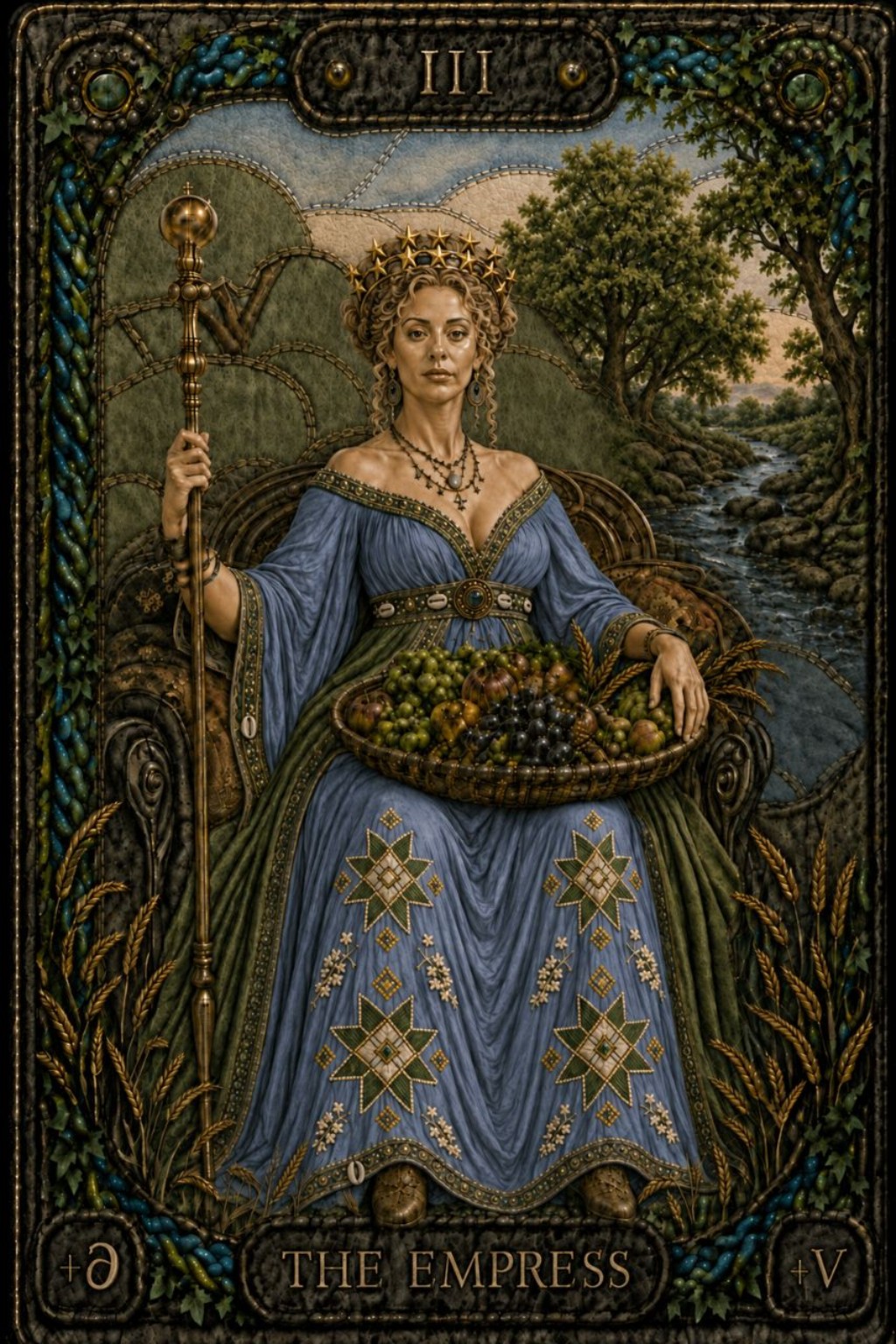
So Libra's question is not “How can I make this sound nicer?” but what difference will allow people with different interests to make one real decision?
What failure looks like
Failure often hides inside a flawless conversation. Everyone nodded, no one raised their voice, and everyone liked the wording. Then it turns out that:
- the specialist meant a danger threshold, while the manager dismissed it as the specialist being overly cautious;
- the organiser promised a small group, while the client understood that to mean an expensive private tour;
- the employee repeated the assignment but explained it as serving an entirely different purpose;
- each party agreed with their own version of the word “reasonable”.
There is an opposite mistake too: smoothing away the very distinction that made a decision necessary, all for the sake of agreement. The result is a sentence no one objects to and no one knows how to act on.
The test is simple. Ask the participants separately:
- Which two cases are we distinguishing?
- Which detail changes the decision?
- What does this decision give you personally, and what does it cost you?
- Where do you disagree?
If the participants independently name the same two cases and the same detail that changes the decision, the explanation worked—even if they judge the result differently. If the only thing they have in common is a polite “yes”, each person has merely agreed to their own interpretation.
Where this scene belongs in the series
In Aries, one person makes a distinct proposal, asks a question or states a refusal—so that the other knows what they are answering and what will change depending on their reply. In Libra, attention moves to a shared measure for the decision, even though different things matter to each person. In Virgo, understanding becomes visible in the next concrete case; in Scorpio, it must remain useful after the familiar order changes. All the versions explored so far are gathered in the growing note “Mercury through the signs: how understanding works in real life”.
If we treat it as a theme of the times
Watching one period in the sky give way to the next becomes more interesting if we do not expect everyone to turn gentler after 10 September. We can simply pay closer attention to places where people with different interests have to act on the same decision.
Perhaps the revealing questions in such a period will not be about elegant compliments at all, but these: What matters to each of us? What tells us it is time to act differently? Does the person on the other side see it too?
Different values do not necessarily create a problem. People can live happily with different views for years. The issue begins where their answers have to meet in one action, one deadline, one rule, one purchase or one refusal.
In short
Mercury in Libra means turning an understood difference into a standard that people with different interests can all use.
Not “everyone agrees now”. Not “everyone was told what they wanted to hear”. More simply: the person who cares about something else can still see where the difference lies and what it changes for them.