Sun in Cancer is easy to describe with familiar words: family, care, closeness, protection, and home. But that turns a sign into personality and an operation into kind behavior.
Our model combines two different things.
The Sun is the work by which a source produces a separable output: a technique, method, formulation, scheme, or object—something that can be pointed to and taken up by another person.
Cancer is an environment in which preserved content receives its boundary from an encompassing circle: “this belongs to us because it is already inside our shared whole.”
The combination therefore reads:
A source produces a definite output that enters shared life and becomes available to the circle's participants.
The Sun does not require novelty on a world scale. We need only show what was produced in the chosen scene. Nor is “everything keeps working after the person leaves” enough: a state formed by repeated experience can do that too. A solar result must be something that can be named and taken.
Operation and environment—not two cards for one idea
In the book's correspondence, the Sun is represented by XIX The Sun, and Cancer by VII The Chariot.
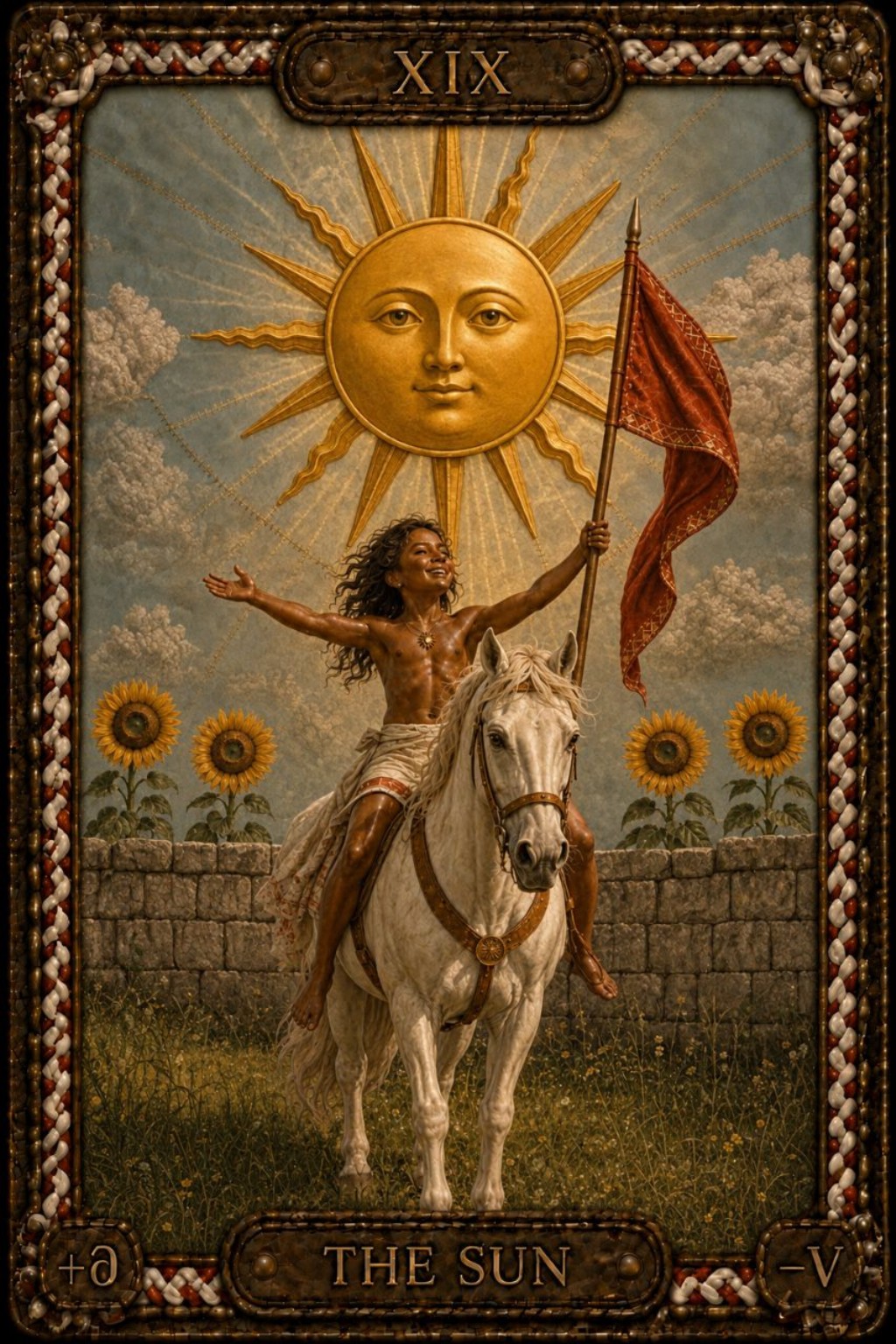
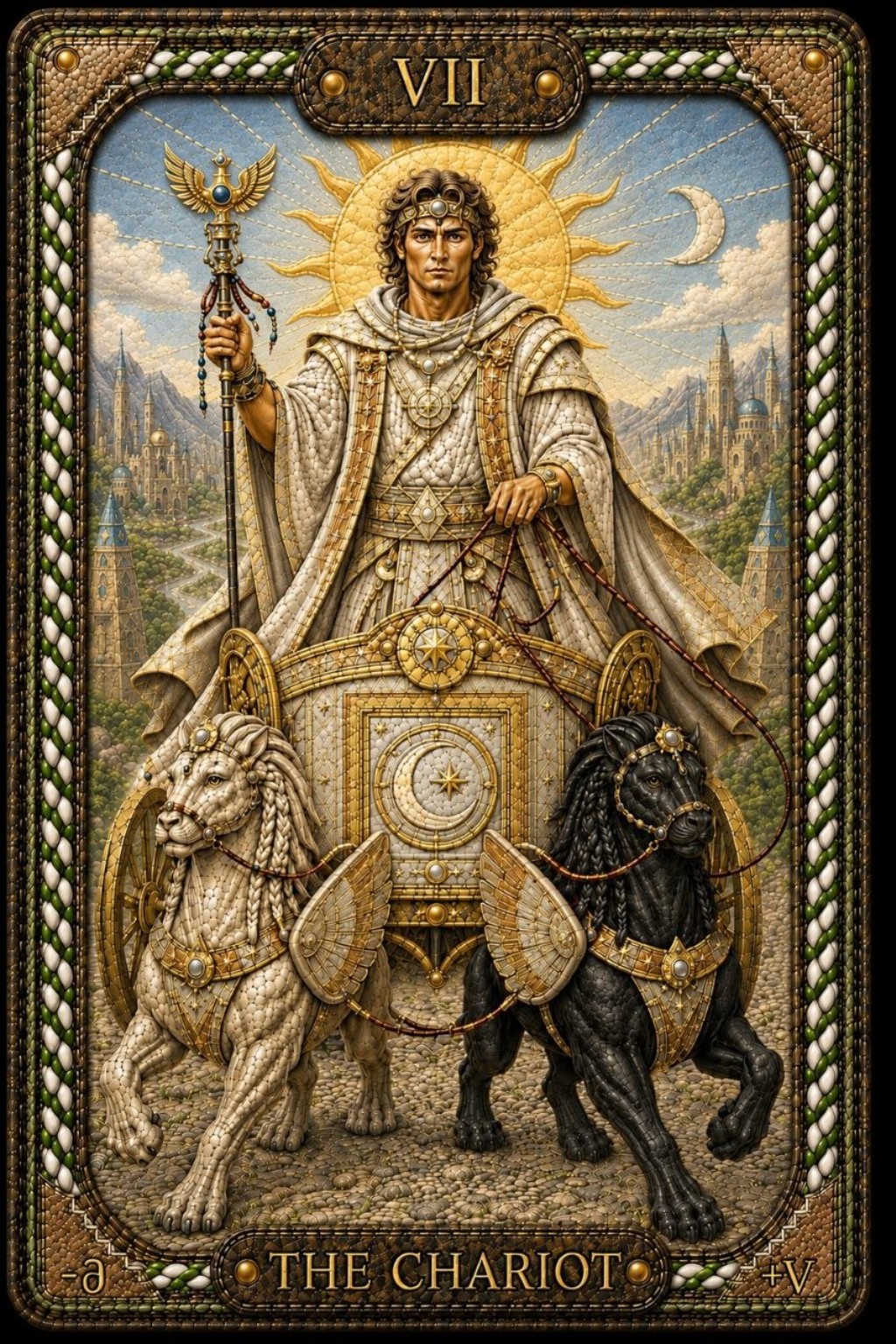
The first card depicts an operation: a result has come out from its source and can be presented. The second depicts an environment of belonging to an encompassing whole.
Neither card proves the other's meaning. Work and environment are first derived from a life scene; the image is read afterward.
A family after a hospital discharge
After their father leaves hospital, his children help him in turns. Each leaves long voice messages for the next, but important points disappear among details.
Lisa proposes a three-part form:
- what changed;
- what was done;
- what the next person should know.
A week later Vera, Denis, and Galina all use it. We can now point to what Lisa produced: not “care in general,” but a three-part handover form. Other people can take it up, and it enters the family's shared work.
This does not mean the form is unprecedented everywhere. Thousands of families may use three similar questions. The solar test does not require otherwise. In this scene, Lisa produced a definite output and the circle took it into use.
What if something simply remains in people?
Suppose Lisa's presence has made everyone alert to an anxious pause in their father's voice. Nobody consults an instruction; repeated experience has prepared the response in advance.
This is a real result, but it has another structure. One cannot take “the family's readiness to become alert” and hand it over as a scheme. It cannot be pointed to as an output; it can only be observed in the changed response. That is the Moon's work.
Thus “does it continue without the author?” is insufficient: both the message form and the family's state may continue after Lisa.
The separating question is:
Is there something another person can take?
A form, technique, or object is a solar output. A prepared state is a lunar result.
A team example
After incidents, a team habitually looks for someone to blame. A manager produces a concrete output: an incident card with four fields—service restoration, facts, decision, and review date.
While the manager conducts every review, the card may remain only a prop in that person's work. When on-call engineers take it and conduct reviews themselves, the output has separated and entered the shared circle.
In time the team may also enter a calm working state as soon as an incident begins. That is a lunar result of repetition. It supports the solar one but is not identical with it.
What Cancer contributes
Cancer does not produce the card or teach the team. A sign does nothing. It tells us where the output has entered: a circle that already treats the incident, care for the father, or a family move as its shared concern.
The same card sold by its author as an independent product would stand in another environment. In the Cancer scene its boundary comes from belonging: “our people” use it because it has entered our way of living and responding together.
A practical test
First name the object: not “my care,” but, for example, the handover form.
Then ask:
What exactly was produced?
Can other members of the circle take it up?
Did the output enter shared life rather than remain the source's private technique?
If the answer is only “everyone feels calmer with me,” the object has probably changed: we are talking about people's state. It matters, but it is not a solar output.
In short, Sun in Cancer is not a person who helps everyone or the author of an unforgettable feeling. It is a situation in which a source produces a definite output and an encompassing circle can take it up as part of shared life.