Why is Taurus a bull? Why is Aries a ram, Libra a pair of scales, Scorpio a scorpion — and why is Aquarius a human figure carrying water? And why do the Hierophant, the Emperor, Justice, Death, the Star and the other Major Arcana appear alongside these signs in Tarot?
The usual explanation begins with the picture. A bull looks solid, so Taurus becomes “stability”. A lion looks regal, so Leo becomes “pride”. Scales balance, so Libra becomes “harmony”. A scorpion stings, so Scorpio becomes “danger” and “crisis”. More associations are then attached until a sign can be made to mean almost anything.
Here I want to reverse the direction.
In Where Did Astrology Come From?, the twelve signs are first derived without animals and without the familiar catalogue of personality traits. What emerges is twelve different environments: twelve ways a situation can be structured. An environment does not itself decide, analyse, communicate or expand. Those are operations that may take place within it.
So the order matters: structure first, then the element as an image for a pair of coordinates, then the phase, and only then the historical questions: why this sign, and why this Tarot card? If an old image captures only part of the structure, we should say so. Otherwise any picture can be made to fit after the fact.
Four combinations, four elements
+∂ means that the boundary is its own: a thing or whole is defined from its own contour. −∂ means that the boundary becomes visible through a relation — another party, a common measure, comparison or an external channel.
+V means that there is something capable of continuing through another carrier or form. −V means that such transfer is not part of this structure: what matters remains in the boundary or relation already present.
+∂ −V is Fire: its own hearth, its own edge. A flame exists where it burns; it is not given its shape by a vessel.
−∂ −V is Air: distance, relation, the space and measure between points. Air belongs to no single object.
+∂ +V is Earth: a bounded whole with its own centre and something that can continue through its forms, products, traces, roles or route.
−∂ +V is Water: the content persists, while its route and shape come through a vessel, channel or connection.
Each combination then appears in three phases. In the cardinal phase the situation is coming into being. In the fixed phase it already exists and holds together. In the mutable phase the existing form is no longer sufficient and continuation beyond it becomes visible.
Aries: cardinal Fire — why a ram, and why the Emperor?
Aries is +∂ −V: Fire in the cardinal phase. Imagine a blank page before the first line, or a clearing where nobody has yet decided where the stage ends and the audience begins. There is no established boundary to appeal to because it does not exist yet.
Aries is therefore not “the one who makes the first move”. That already describes an operation and quickly turns Aries into Mars. The environment is more basic: a world before the first boundary has been established.
Why a ram? Not because rams are supposedly aggressive. Remove the action and the horns remain: the animal carries its forward edge on its own body. Even standing still, its boundary is visibly its own. That is a strong image of +∂. It is less good at showing cardinality, because the adult ram’s horns are already there. The symbol captures the self-owned edge better than the moment in which it first appears.
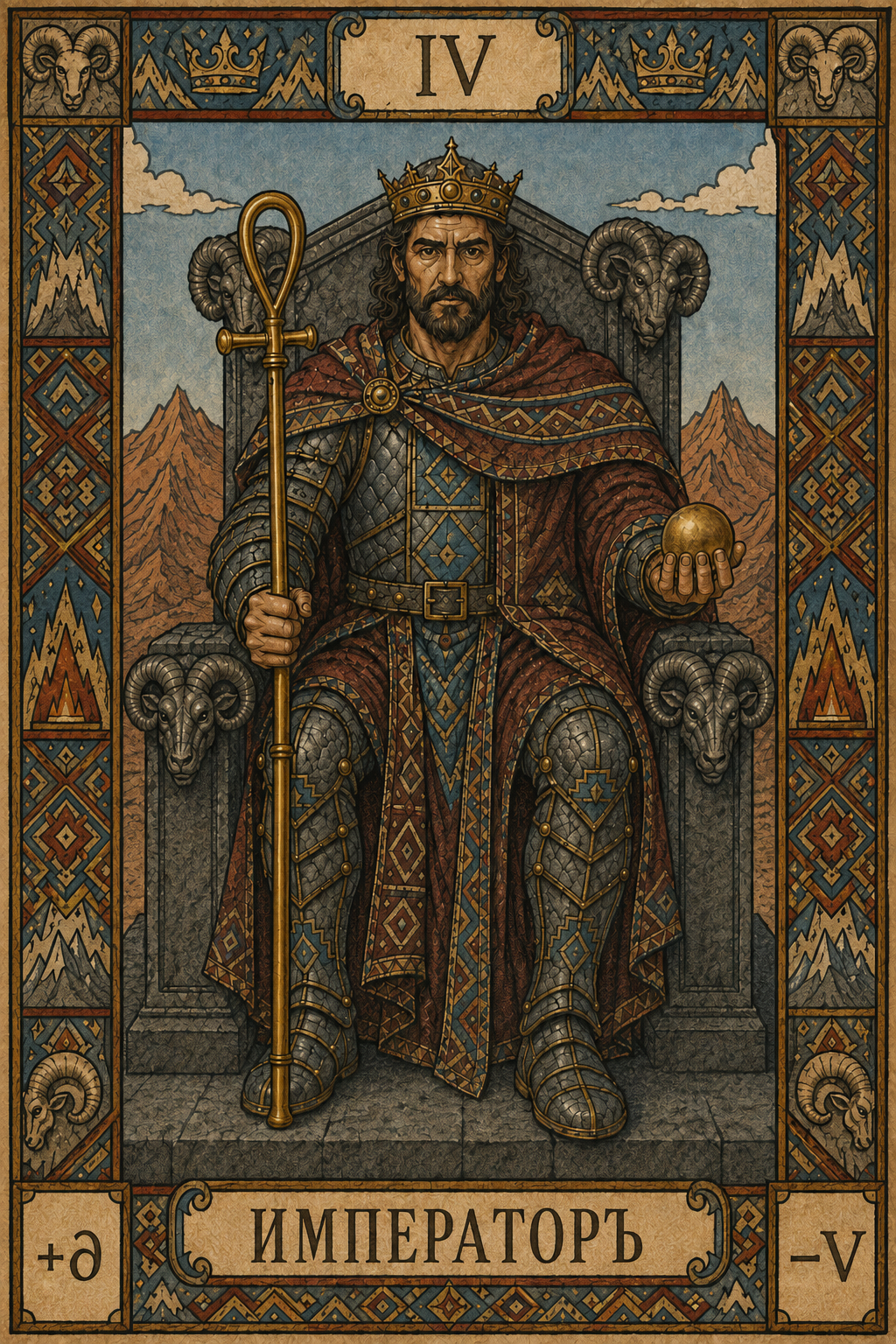
The Emperor supplies that missing aspect. A warrior normally acts inside an existing order; an emperor is the point from which a local order receives its boundary. The throne marks a centre from which centre and periphery, subject and outsider, command and private opinion become distinct. Will and initiative are therefore possible actions in the Aries environment, not its definition.
Taurus: fixed Earth — why a bull, and why the Hierophant?
Taurus is +∂ +V: Earth in the fixed phase. The form already exists and sustains itself from within. A garden persists through repeated cycles of soil, roots, water and growth. An organism takes in food and turns it into its own tissue. A workshop receives new material and repeatedly produces recognisable work.
This is why stability belongs near Taurus, but it is an effect. The deeper fact is that an established form can keep producing the conditions of its own continuation.
Why a bull? “Because bulls are stubborn” tells us little. The living body is more revealing: it continually takes in grass, water and air and turns them into its own mass, heat, movement and life. The bull does not merely stand firm; it continually remakes itself. Food, substance, land, accumulation and bodily life then become understandable neighbouring themes. Slowness does not follow: a self-sustaining system can work very quickly.
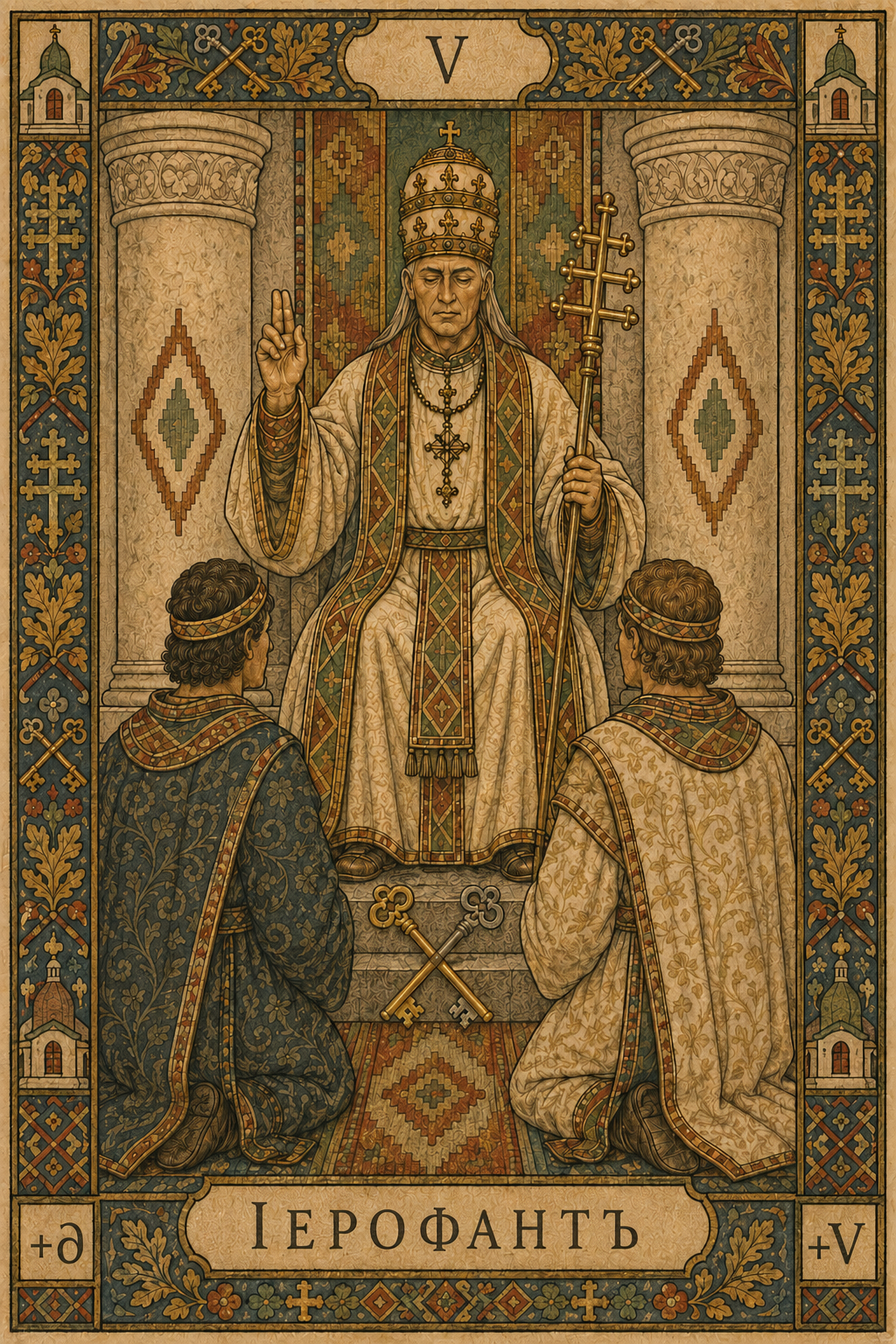
The Hierophant gives us a cultural version of the same structure. A rite repeats and once again produces a recognised event. A university educates new generations while remaining the same institution. A craft tradition passes on a form that the apprentice enters rather than invents. Tradition here is not “liking old things”; it is a human case of a form capable of reproducing itself.
Gemini: mutable Air — why twins, and why the Lovers?
Gemini is −∂ −V: Air in the mutable phase. Different positions do not automatically share one point of view. Two people on opposite sides of a building see different things; “left” for one may be “right” for the other. What is obvious to one person need not be obvious to another.
Gemini itself does not “communicate”. Communication is already a Mercurial operation. The environment is the prior fact that positions do not coincide and are not enclosed in one ready-made viewpoint.
Why twins? Two almost identical people make difference unusually visible. Their resemblance does not turn them into one body or one position. The image is therefore stronger as a picture of persistent difference than as the usual “dual personality”.
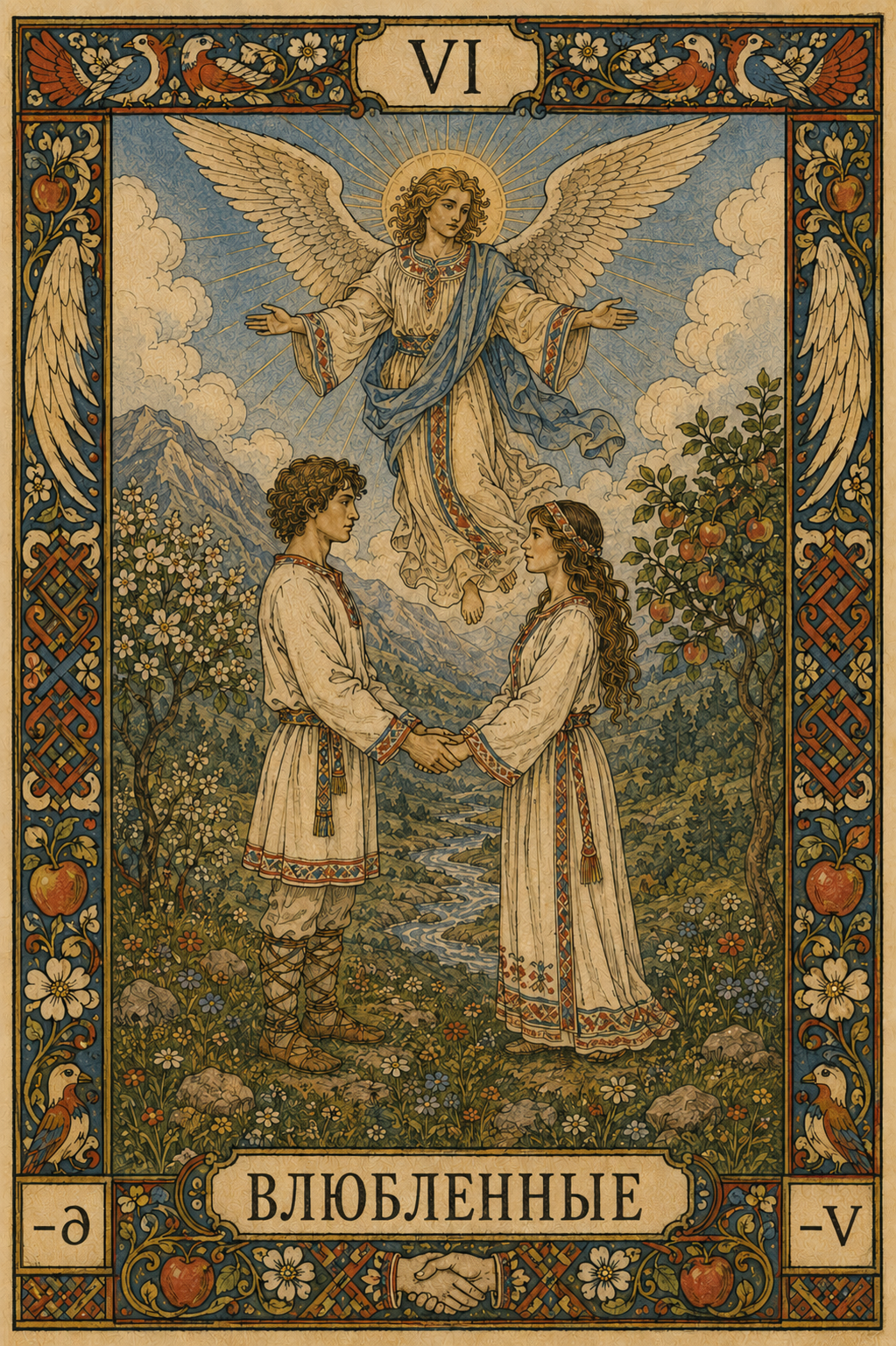
The Lovers show two distinct parties in relation without collapsing them into one. Even choice requires distinct alternatives. Love is a powerful human image precisely because intimacy and separateness coexist: however close another person becomes, they are still not me. Speech, comparison, translation and exchange are operations that naturally arise in such a world.
The image does have a limit. The mutable quality is less visible in the Lovers than the difference between the two positions. The card shows −∂ very clearly: the other remains other even in intimacy. Mutability becomes more visible when one position no longer suffices and choice, translation or movement between viewpoints becomes necessary precisely because the viewpoints do not coincide.
The image has a limit, though. The Lovers show distinct positions very well, but mutable phase less directly: the scene does not by itself show that an earlier common form has ceased to be sufficient. That aspect appears in the need for choice, translation and passage between viewpoints that do not coincide.
Cancer: cardinal Water — why a crab, and why the Chariot?
Cancer is −∂ +V: Water in the cardinal phase. There is not yet a ready-made circle of belonging. Several people may meet without yet being a team; two people may live together without a shared household having acquired its own contour. At some point a boundary appears: these are the people for whom we are responsible; this is ours; this is inside and that is outside.
Cancer is therefore not simply “home”. Home is already too complete. Cancer is the moment in which the distinction between one’s own and what lies outside first becomes real.
Why a crab? The shell makes inside and outside immediately visible. Yet this is also where the old image is imperfect: an adult crab’s shell already exists. It shows the result of a boundary better than the cardinal moment of its establishment.
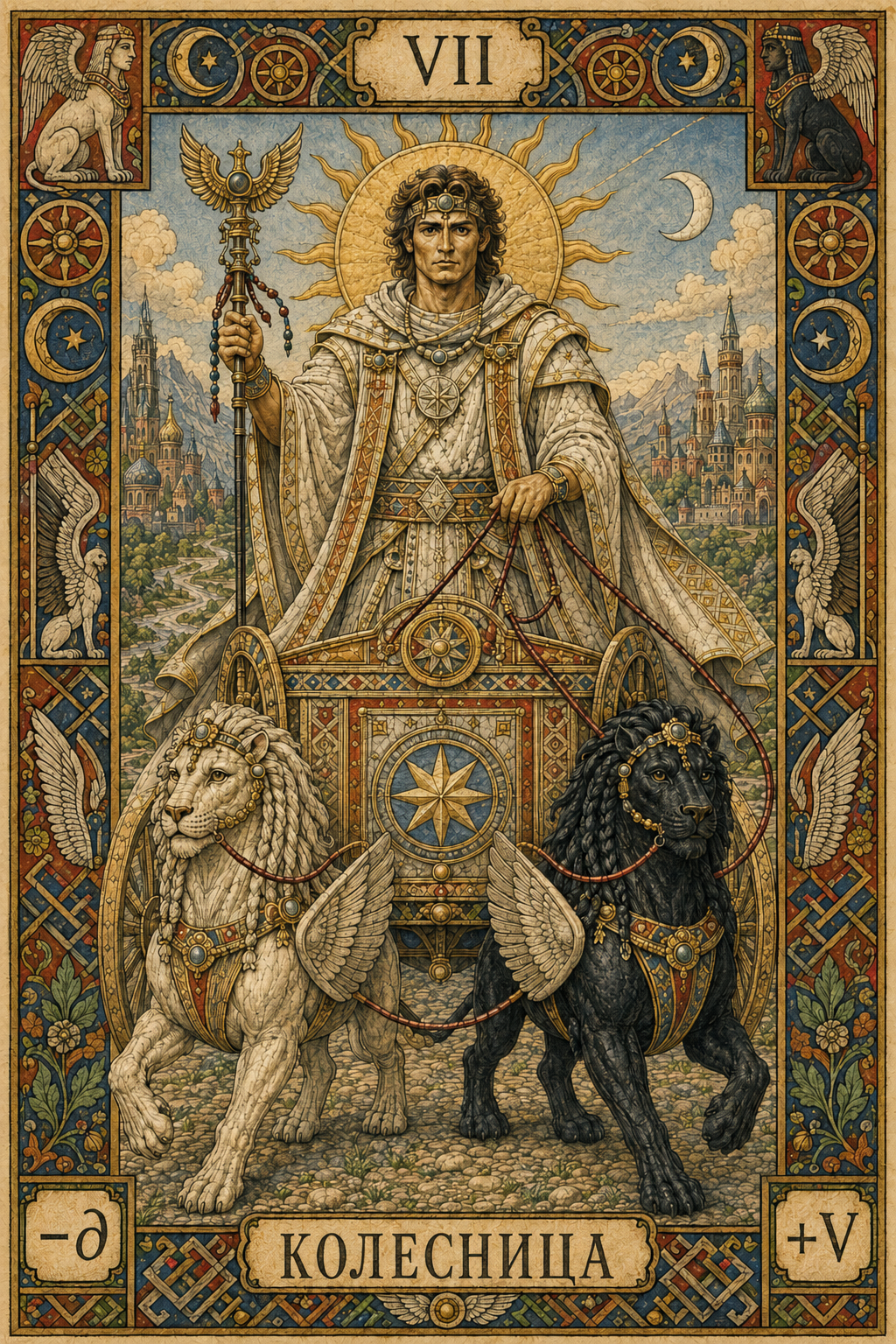
The Chariot is stronger here. What matters is not simply that wheels, body, harness, animals and driver make one mechanism, but the distinction between inside and outside. The person within the chariot does not move by themselves; they are carried by the whole they have entered. The card is therefore deeper than “victory”: it shows a new circle of belonging whose members can continue because they are now inside it.
Leo: fixed Fire — why a lion, and why Strength?
Leo is +∂ −V: Fire in the fixed phase. A whole already exists, has its own centre, and that centre remains recognisable in what comes from it. A workshop has a style visible in different objects; a director’s hand can be recognised across different films; a person can be recognised by phrasing or gesture.
This is not an instruction to “express yourself”. The environment simply has this structure: the whole has a centre of its own, and that centre reappears as itself in each new manifestation. Nothing has to be carried away as a separate payload; the source remains in the whole.
Why a lion? The mane almost draws a circle around the head; the animal reads visually as a self-contained centre. Royalty, creativity and pride can then arise as secondary associations. A visible centre does not, however, require an audience.
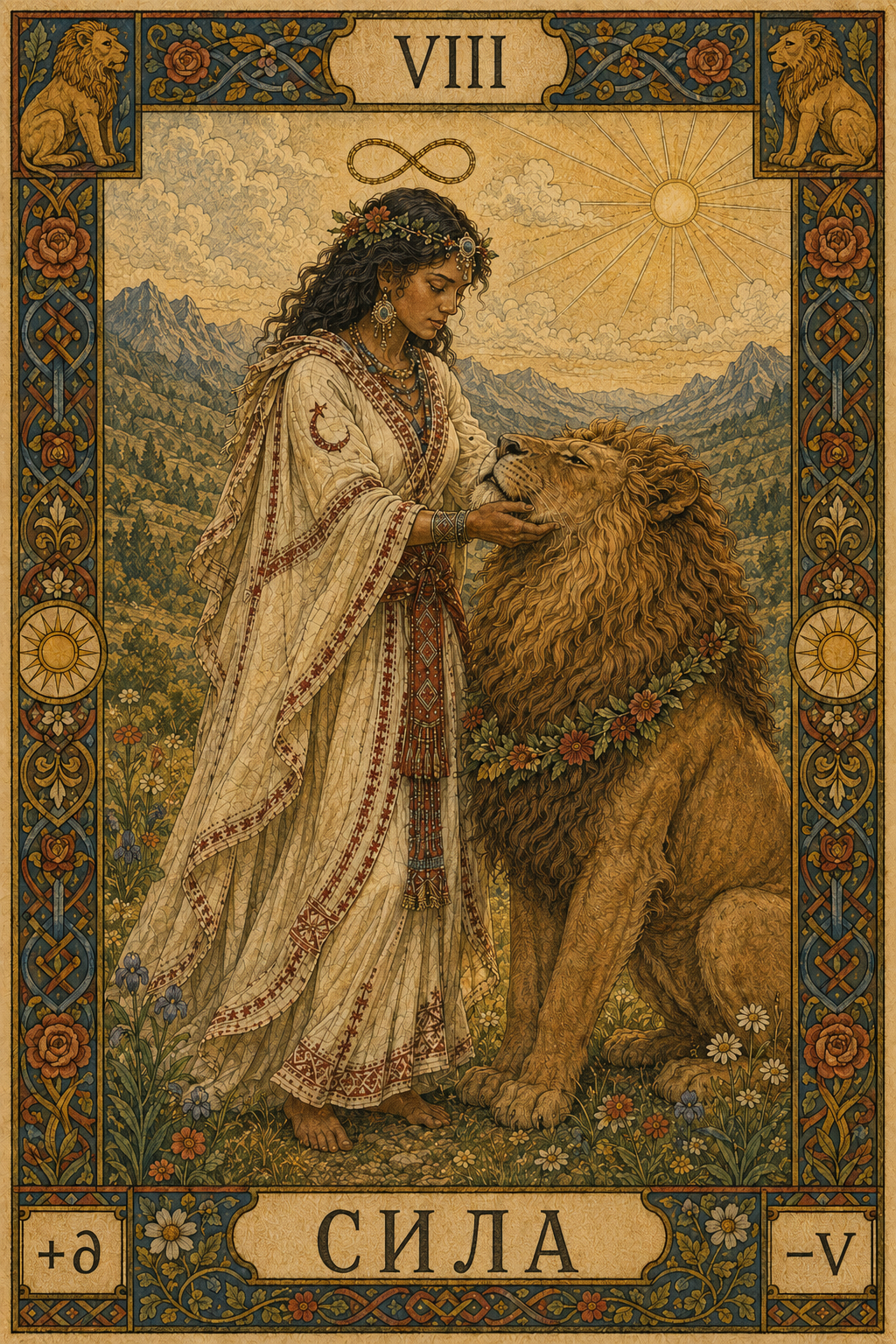
In Strength, the lion remains a lion. Its power is not removed or replaced by someone else’s. The woman enters into relation with it, but the source remains within the animal. Strength is not “hit harder”; it is the whole’s own power remaining its own even as it enters a relation.
Virgo: mutable Earth — why the maiden, and why the Hermit?
Virgo is +∂ +V: Earth in the mutable phase. A particular case never disappears into its general description. A drawing says “brick wall”; the wall in front of us has this cracked joint, this pipe and this doorway. A recipe says flour and water; today’s humidity makes this dough behave differently. A protocol describes a typical case; the actual person remains particular.
“Virgo analyses” would already describe Mercury. Virgo itself is the world in which the concrete instance retains its own edge.
This is where +V matters. A general rule can continue only through the particular case that actually carries it. A recipe, protocol or design survives by being embodied in this instance and by meeting what is really here; if it fails here, the general label is not enough.
Why the maiden? This historical image is less literal than Libra’s scales or Taurus’s bull. It can be read through separateness and the state of being unmixed — a thing retaining its own contour. That helps explain later themes of cleanliness and sorting, but it does not depict the whole mutable structure.
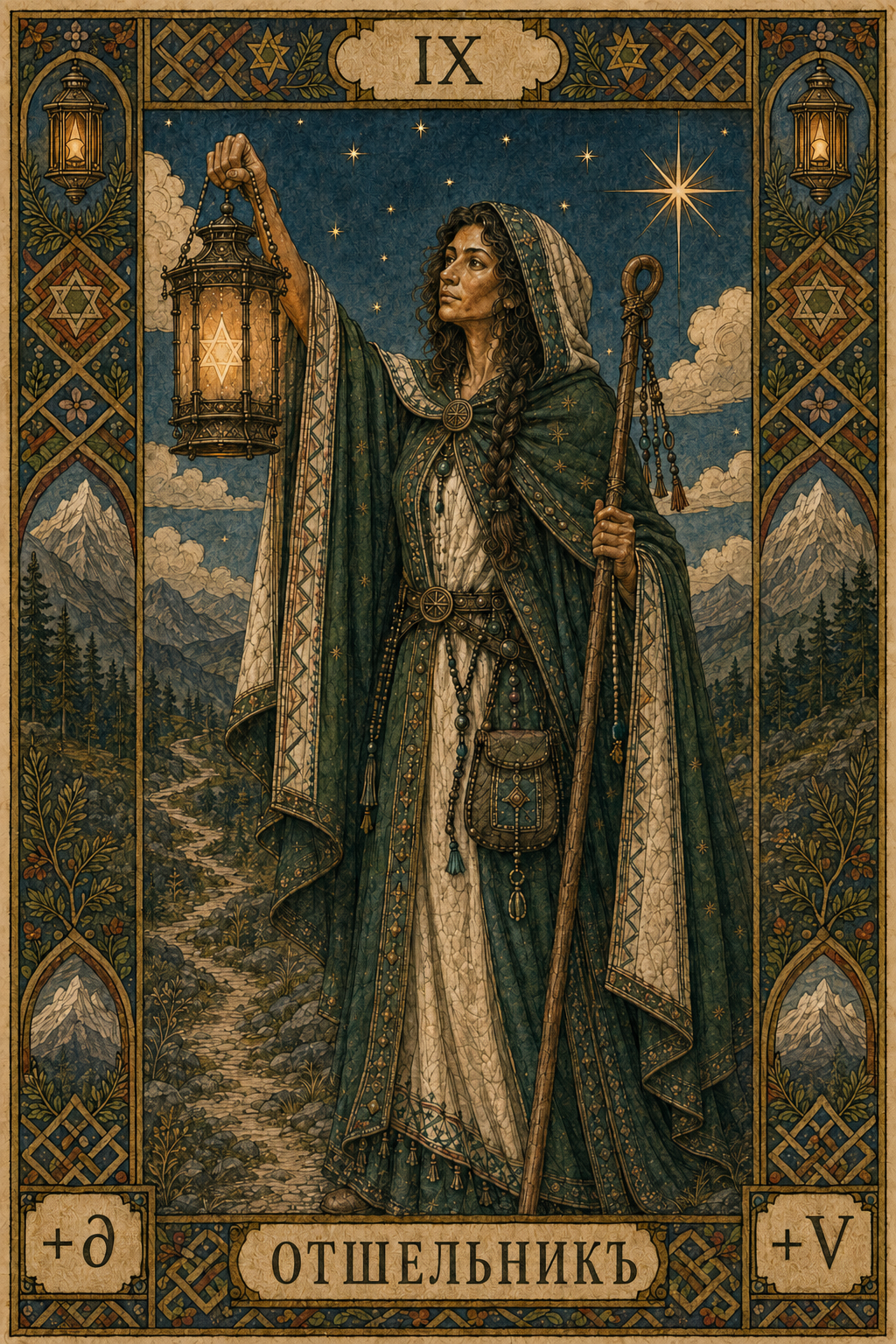
The Hermit is much stronger. His lantern does not illuminate the world; it lights a small patch immediately before his feet. Night remains night, but this place becomes visible enough to carry the next step forward. Analysis, diagnosis and adjustment are operations that naturally arise here, but the environment itself is the irreducible particularity through which continuation has to pass.
Libra: cardinal Air — why scales, and why Justice?
Libra is −∂ −V: Air in the cardinal phase. Two parties exist, but there is no common measure between them yet. A seller and buyer may disagree on a fair price; two heirs may each regard their own contribution as decisive. Repeating either private measure cannot settle the relation.
Why scales? Neither pan says much by itself. Its position becomes meaningful relative to the other. This is an unusually direct image of −∂: meaning comes through comparison. Harmony is too narrow a definition, because scales can display a severe imbalance. What matters is the common measure in which the two sides can become comparable at all.
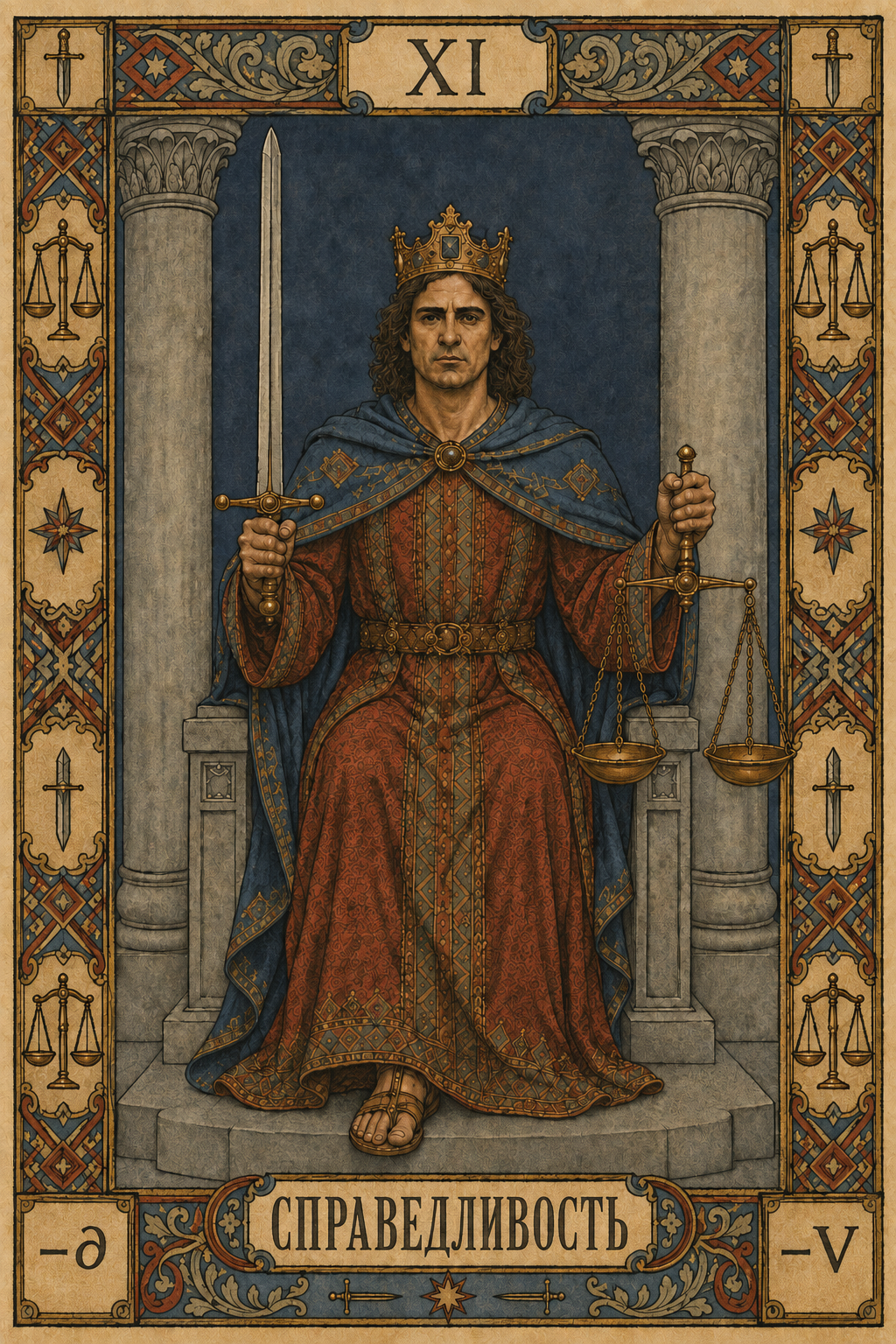
Justice gives this a human scene. A court brings private positions under a rule that belongs wholly to neither. The scales are not decoration for “be fair”; they depict the structure: different things become comparable through a third measure. The result may be compromise, but it may also be a hard judgement.
Scorpio: fixed Water — why a scorpion, and why Death?
Scorpio is −∂ +V: Water in the fixed phase. The whole exists, but part of what allows it to continue lies in an external channel. A house seems self-contained until utilities fail. A company seems whole until the person carrying a critical competence leaves. A family enterprise lasts because knowledge and property pass between generations. A body is a whole while blood continually carries substances between its parts.
The channel is easy to ignore while it works; crisis makes it visible.
Why a scorpion? Its tail and sting provide a striking specialised channel of action. The image does not capture inheritance or infrastructure, but it does capture dependence on a distinct conduit. This is why “crisis” appears so naturally around Scorpio: not because Scorpio loves destruction, but because dependence becomes easiest to see when the channel breaks.
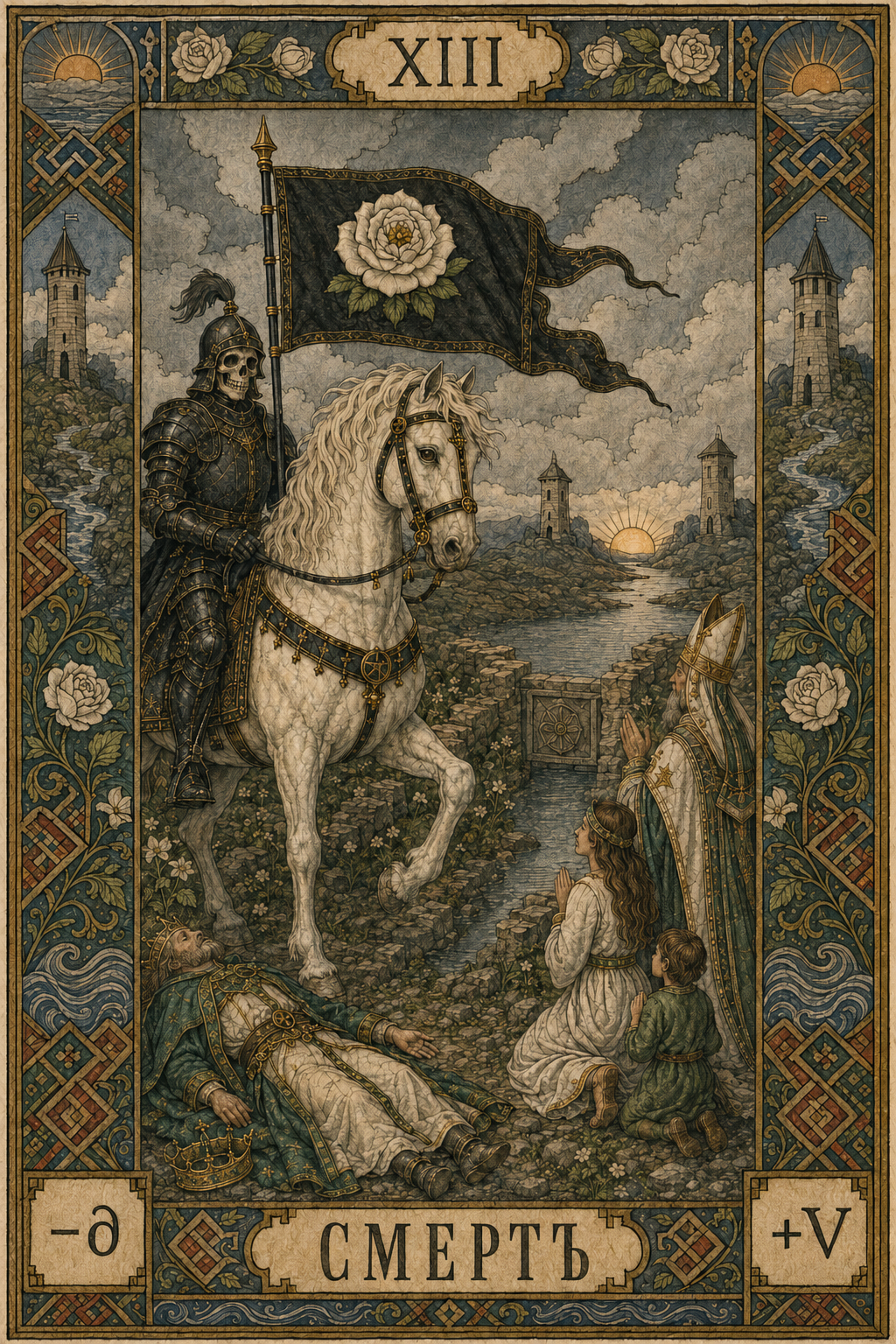
Death is important here not as a general formula for “changing carriers” — that would belong more naturally to mutable Water. In fixed Scorpio it shows something else: how much an existing whole depends on the channels that keep it alive. While a person is alive, inheritance law remains almost invisible; while an organisation works, the relationships holding it together are easy to overlook; while circulation is intact, it feels like background.
Death breaks one of those channels and makes the dependence suddenly visible. Property must be inherited, access reassigned, duties redistributed, memory carried by other people. The crisis does not create the dependency; it reveals what had already been held together through that channel.
That is why Death remains a powerful image of fixed Water without turning Scorpio into Pisces.
Sagittarius: mutable Fire — why an archer, and why Temperance?
Sagittarius is +∂ −V: Fire in the mutable phase. The previous form has been left behind, yet continuation has not dissolved. Different stretches are connected by a direction of their own. A mountain path may pass from forest to rock to snow and still be one route. Education may move from school to university to work while remaining one line of development.
Sagittarius does not itself “strive towards a goal”. Striving is an operation. The environment is one in which forms change while a self-owned line connects them into a path.
Why the archer? Remove the act of shooting and a useful geometry remains: the bow is here, the arrow is already there, and a line of direction joins the two. The old carrier is behind; the next stretch is ahead; direction prevents them from becoming unrelated episodes.
That is the point of −V: the arrow is not carrying a separate content from the old form. What persists is above all the direction. Sagittarius is therefore not a vessel transporting a payload from one form to another; it is a line that remains its own after the previous stretch has ended.
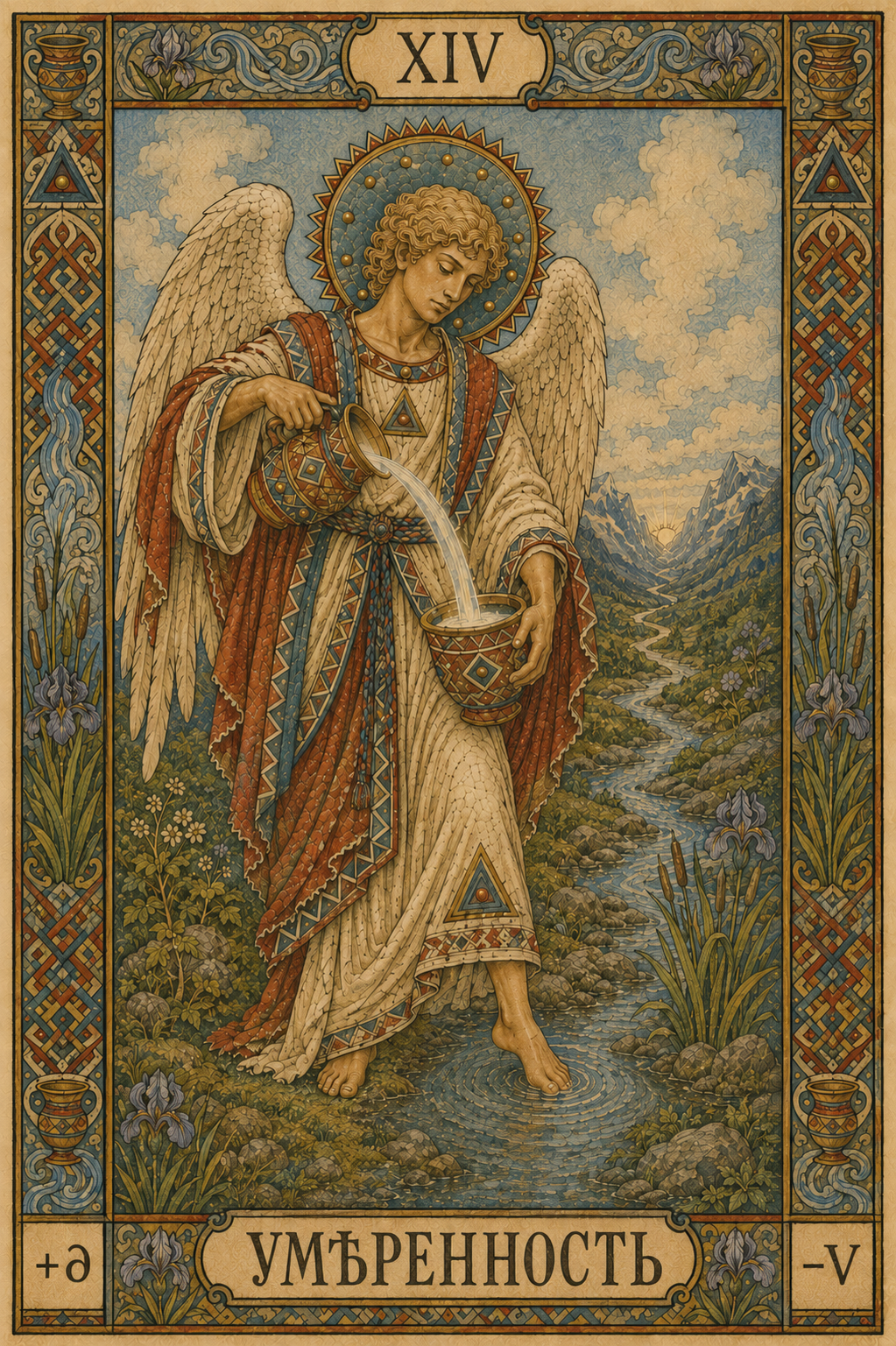
Temperance is especially useful because it shows an operation within the environment, not the environment itself. Sagittarius has −V: content does not pass onwards by itself. If something really must survive a change of form, it has to be poured — with enough proportion to avoid spilling it, but not so little that it remains trapped in the old vessel.
The two vessels therefore do not mean that Sagittarius itself “transfers content”. They show the extra work required when the environment preserves direction rather than a transferable payload. That is where Temperance becomes more than a moral injunction to be moderate: it is the art of making a transition without losing what must be carried.
Capricorn: cardinal Earth — why a goat, and why the Devil?
Capricorn is +∂ +V: Earth in the cardinal phase. A new whole first gathers around what it recognises as its own central concern. A conversation becomes a company when roles, money, deadlines and responsibilities form around the work. Rooms become a household when they acquire an order that belongs to that household.
The important point is that the boundary is not handed down by the environment. The whole itself determines what belongs to its central concern and what does not.
Why a goat? The weak explanation is that a goat “overcomes the harsh mountain”, because that makes the mountain the source of the boundary. A better image is the goat on a slope with no ready-made path. It joins separate footholds into a route of its own. The path is not supplied in advance; it emerges from the line this body can actually continue.
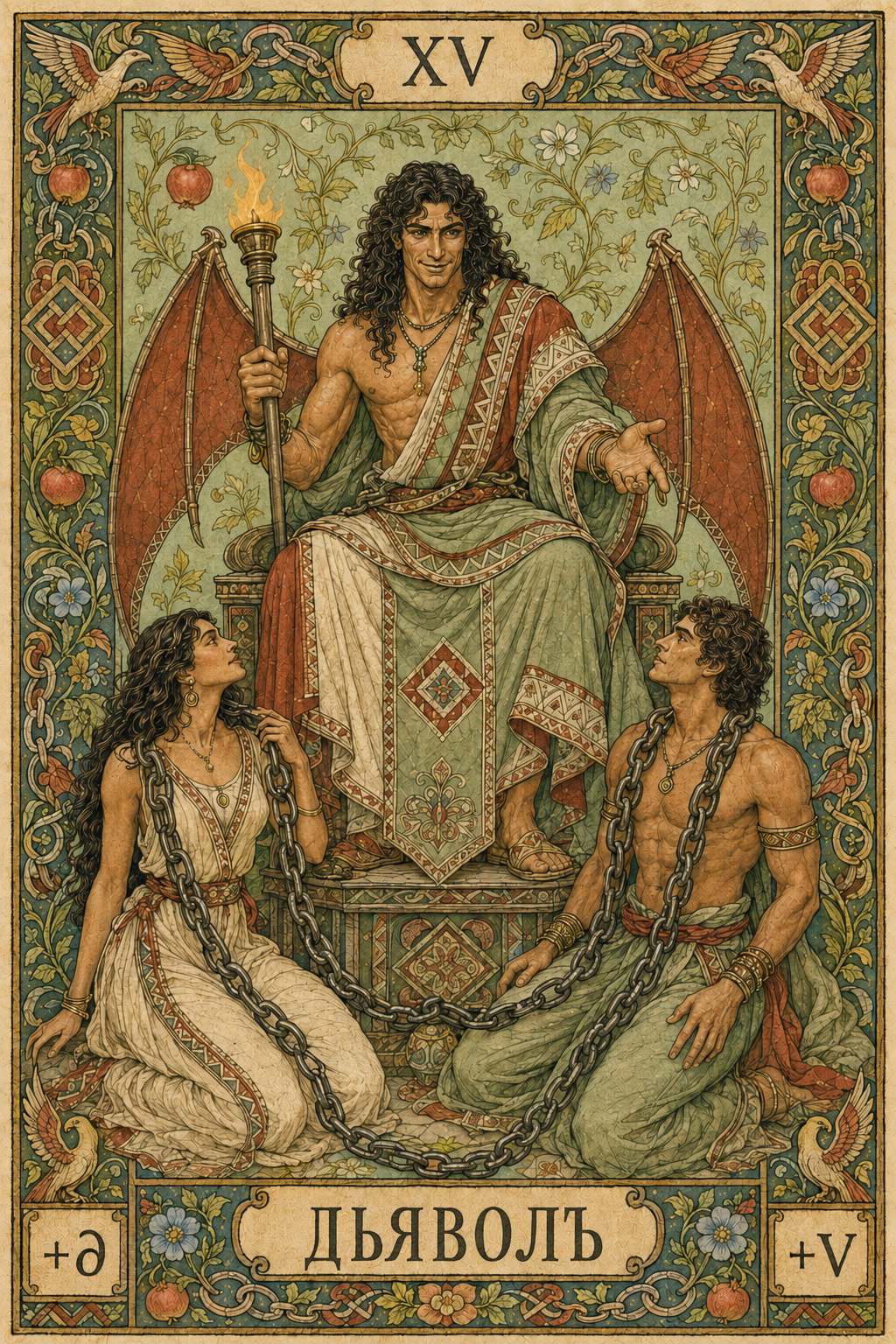
Why the Devil? Because every durable structure has a darker side: what we create to support us can begin to hold us. A company enables common work, then schedules, debts and obligations begin to shape the lives of those inside it. Property gives independence and also demands maintenance. A contract makes cooperation possible and binds the parties. The chains on the card show the shadow of a self-created contour: dependence on what was once built as support.
Aquarius: fixed Air — why the water-bearer, and why the Star?
Aquarius is −∂ −V: Air in the fixed phase. This is the point most easily confused with Pisces. Nothing here has to migrate from one carrier to another. A whole already contains many different cases, held together by one common measure.
Different houses have different owners and façades, yet one address system places them on the same map. Citizens live different lives, yet one law may apply to all. Different instruments can produce measurements that become comparable through a shared scale. Different computers can use one protocol.
That is fixed Air: many different things already coexist, while the common measure belongs to none of them privately.
Why the water-bearer? If we focus on water leaving one vessel for another, the image slips straight into Pisces. A better angle is distribution: one water-bearer brings the same water to many different people. Recipients and vessels differ; what is common is not the private property of any one recipient. Even so, this symbol is imperfect: the water-bearer is an actor, and the image too easily suggests transfer.
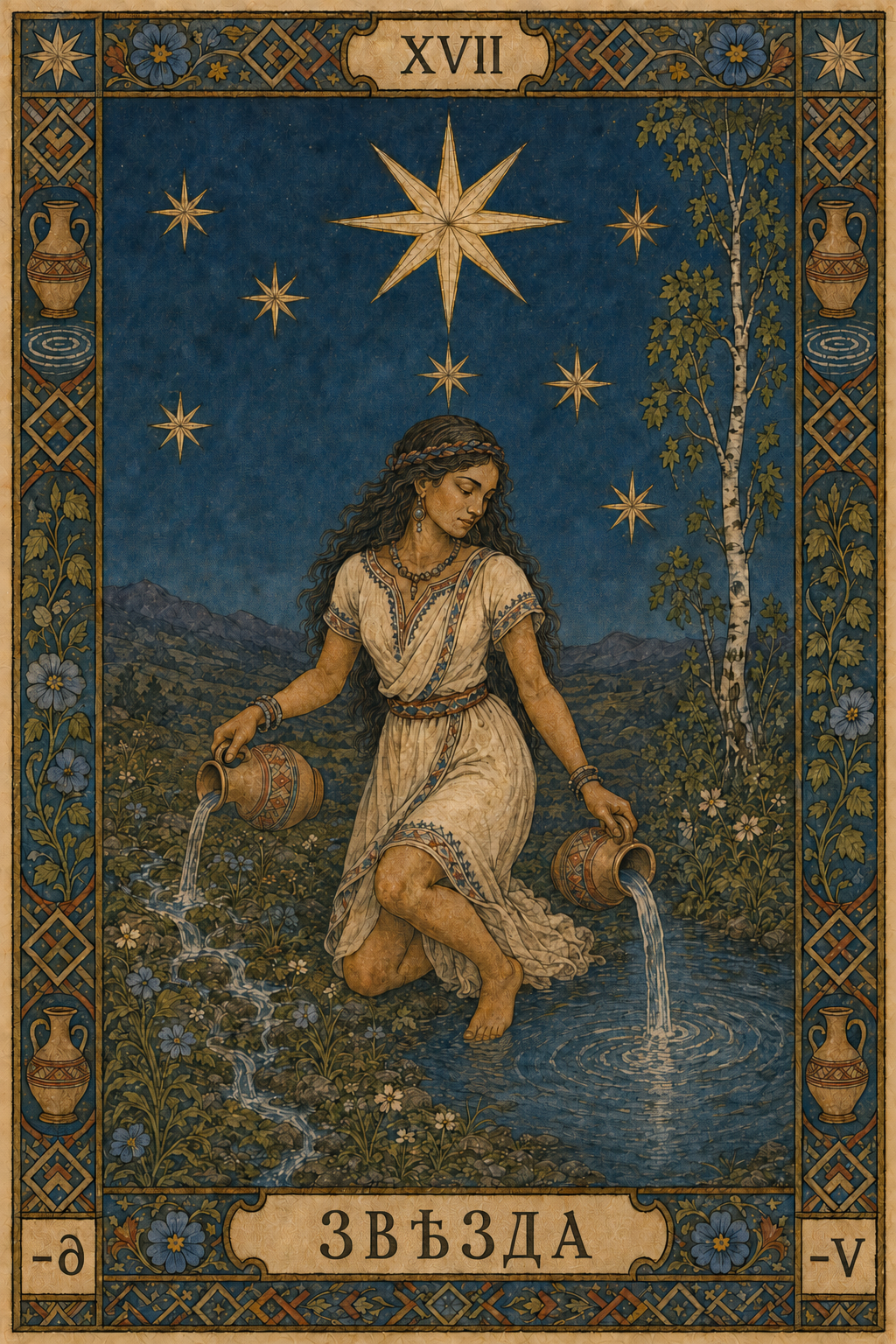
The Star is much better. One star can be seen by many people from different places. It belongs neither to the sailor who navigates by it nor to the traveller nor to the city beneath it. Different positions can all refer to one common point of reference. Hope is a poetic consequence; the deeper image is a shared orientation that belongs to no single observer. Society, equality, networks and common ideas then become understandable secondary themes.
Pisces: mutable Water — why fish, and why the Moon?
Pisces is −∂ +V: Water in the mutable phase. Here we finally reach what is sometimes mistakenly attributed to Aquarius: the old form ceases to carry the whole, while the content continues through another form.
A melody played on another instrument has a different timbre but remains recognisable. A novel translated into another language uses different words while preserving the story. A vanished rite may continue in another festival. A person dies while decisions, habits and memories continue to act through other people. Identity is recognised not because the forms match, but because a relation connects them.
Why fish? Water makes fixed form and direction less decisive than on land. A fish remains itself while continually changing its position relative to the current. Two fish can move in different directions and remain within one medium. The image therefore suits a world in which one rigid form is no longer the main condition of identity, although it does not show transfer between carriers as clearly as Death or Temperance do.
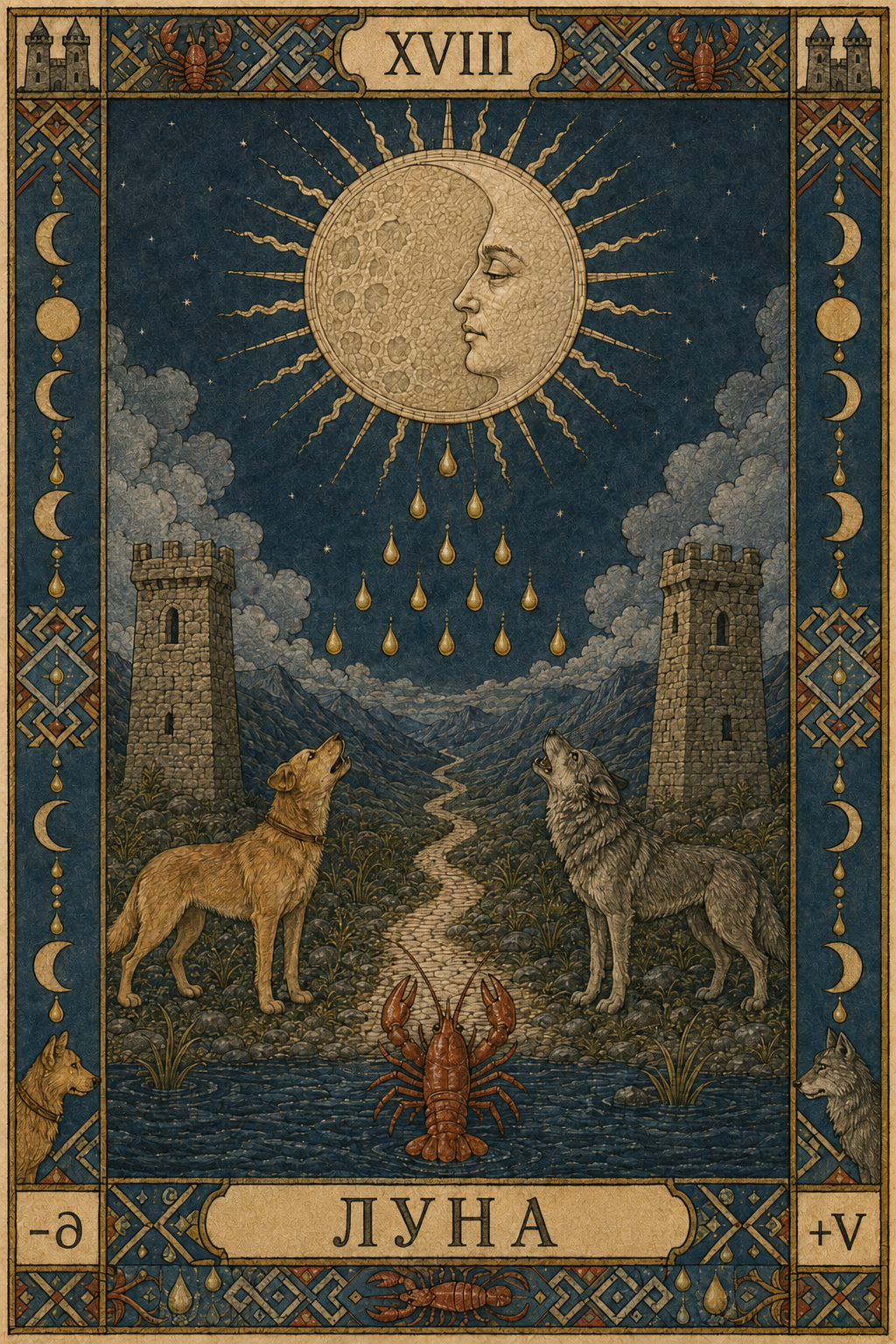
Why the Moon? Moonlight is already indirect light. It is not the source, yet it continues the source’s effect. A reflection is not the object but carries its image. A dream is not an external event but can continue to act after waking. A symbol is not the thing it signifies but carries meaning. Dream, memory, imagination, art and illusion are therefore different cases of content continuing indirectly through another form. Illusion is only one possible outcome; translation is not the original either, yet it may still be faithful.
Four elements through three phases
The zodiac can now be seen as a compact construction rather than twelve unrelated personalities.
The same Fire +∂ −V gives Aries in the cardinal phase, Leo in the fixed phase and Sagittarius in the mutable phase: first a self-owned boundary appears, then a centre remains recognisably itself, then a direction continues after the previous form has been left behind.
The same Air −∂ −V gives Libra, Aquarius and Gemini: a common measure first arising between parties, a common measure already holding many different cases, and distinct positions becoming visible as non-coincident.
The same Earth +∂ +V gives Capricorn in the cardinal phase, Taurus in the fixed phase and Virgo in the mutable phase: a whole first gathers around what matters to it, then an established form turns incoming matter into its own continuation, then a general description can continue only through what actually works in this particular case.
The same Water −∂ +V gives Cancer, Scorpio and Pisces: a circle of belonging first being established, an existing whole depending on an external channel, and content continuing after a change of form.
The element is therefore not an extra adjective — “Aries is also fiery”. The element is the combination of the two coordinates itself, seen through a natural image. The sign is that same element in a particular phase.
A check against the six axes
There is a useful control that does not depend on the traditional names of the elements. Across each zodiacal axis, the two signs share the same phase and the same V, while ∂ is reversed. All six pairs work: Aries–Libra, Cancer–Capricorn, Taurus–Scorpio, Leo–Aquarius, Gemini–Sagittarius and Virgo–Pisces.
That matters because it gives the model a structural check against its own metaphors. A persuasive image is not allowed to move a sign to the wrong coordinates.
Why the familiar associations often still work
We do not have to throw away the familiar keywords; we only have to put them in the right place. Aries may look decisive because decisions become conspicuous where no boundary is ready-made. Taurus is associated with stability because an established form sustains itself. Gemini invites communication because positions do not automatically coincide. Cancer points towards home because a home is one case of a bounded circle of belonging.
Leo can lead to creativity, Virgo to analysis, Libra to harmonising, Scorpio to crisis, Sagittarius to travel, Capricorn to organisation, Aquarius to common ideas and Pisces to symbol and imagination. But the direction of explanation is now different:
structure of the environment → typical life scene → historical image → familiar action or association.
Not “the scorpion stings, therefore Scorpio is dangerous”, but “continuation in Scorpio depends on an external channel; crisis makes such dependence visible; the sting happens to be a vivid historical image of a specialised conduit”.
Not “Aquarius pours water, therefore it moves freely between forms” — that is Pisces. Fixed Air is the common measure holding different cases together, and the Star becomes a shared point of reference for different observers.
And why Tarot matters here
Tarot is interesting because the zodiac signs are paired not with formulae but with human scenes. The Emperor shows a source of boundary. The Hierophant shows a form that reproduces itself. The Lovers show distinct positions in relation. The Chariot shows a newly formed circle carrying those who are inside it. Strength shows a centre of power that remains its own. The Hermit shows the locally illuminated particular. Justice shows a common measure. Death shows an existing whole’s dependence on a channel, most clearly when that channel breaks. Temperance shows the work of transfer required when the environment itself preserves direction rather than a transferable payload. The Devil shows a created contour beginning to bind its creators. The Star shows a shared orientation. The Moon shows indirect continuation through another image.
Some correspondences are remarkably good; others are visibly weaker. That is not a problem. A historical symbol does not have to be a perfect diagram.
But when we move from structure to image, rather than from picture to a convenient list of traits, the old symbols become much more interesting. They stop looking like magical pictograms of personality and begin to look like attempts to show, through an animal, object or human scene, a more general structure of the world.
That is the order in which the system unfolds in Where Did Astrology Come From?: structure first, then element and sign, and only then the historical name and image.