Pluto in Libra is easy to describe with dramatic phrases: “fated relationships,” “transformation through partnership,” “power struggles in love.”
But those phrases leave out the main question: what can a person actually do?
Imagine two business partners who keep fighting over major decisions. Each time they reconcile, one gives way and work continues. A few months later the same conflict returns because they still have not decided who has the right to decide what, or what happens when agreement is impossible.
Eventually they stop arguing about who is right this time and rewrite the agreement: which decisions require both of them, which each can make alone, what happens in a deadlock, and how either partner can leave the business.
That is where the Pluto-in-Libra theme becomes clear.
Pluto in Libra is the ability, after a serious conflict, to change the rules of a relationship so that the next similar situation can no longer repeat in the old way.
Not merely making peace. Not getting your way. Not promising to “communicate better next time.”
It means understanding what in the old arrangement kept creating the same problem and changing it.
Sometimes the change looks completely undramatic: a clear response deadline, a veto right, a new way of sharing expenses, a procedure for revising a price, a rule for breaches, or a way to leave an agreement without a war.
Those details show that the conflict did more than end. The relationship itself now works differently.
Two cards
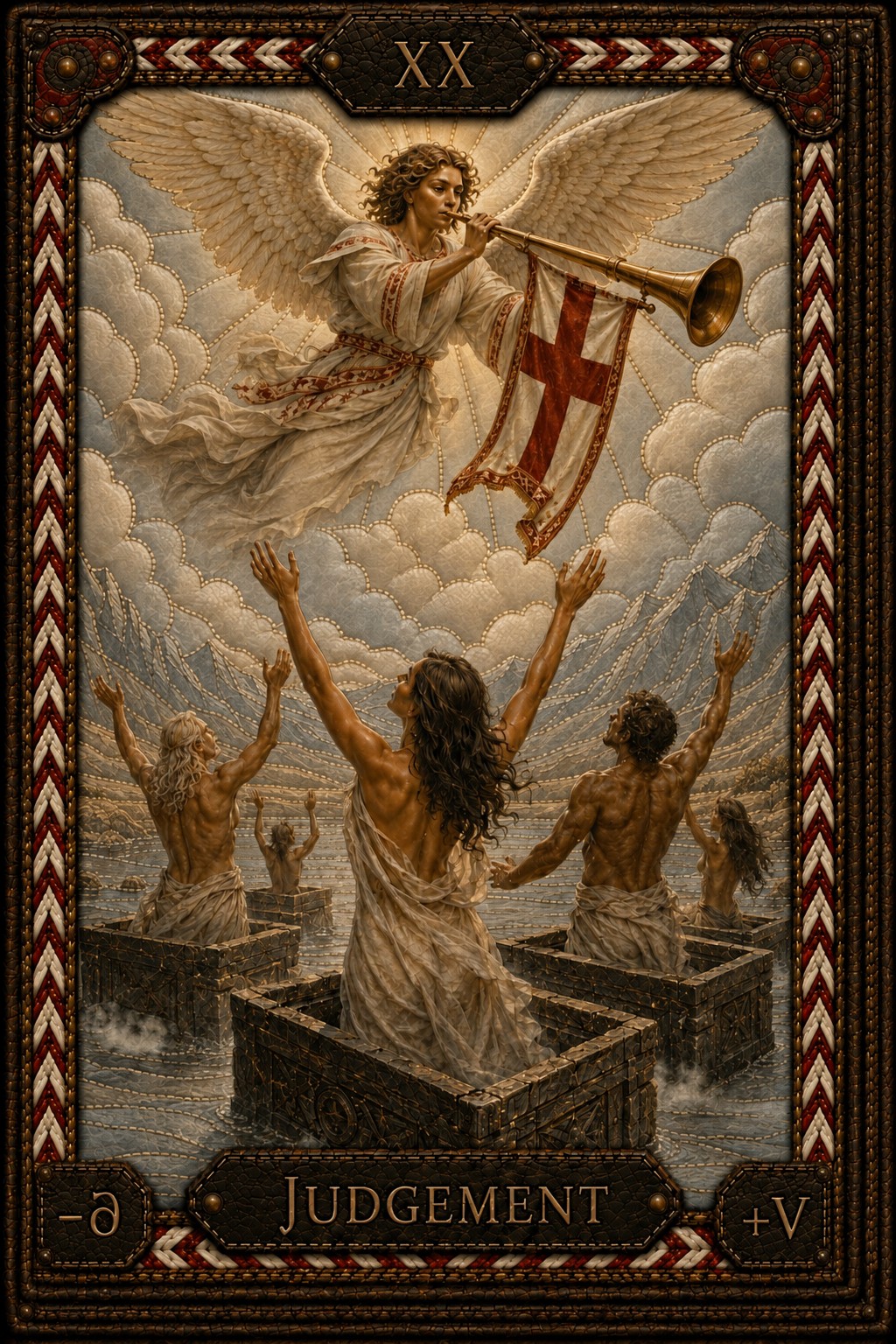
In our system, Pluto corresponds to XX Judgement, and Libra to XI Justice.
Judgement is not about punishment here. Its meaning is simpler: the old order has ended, and continuing in exactly the same way is no longer possible.
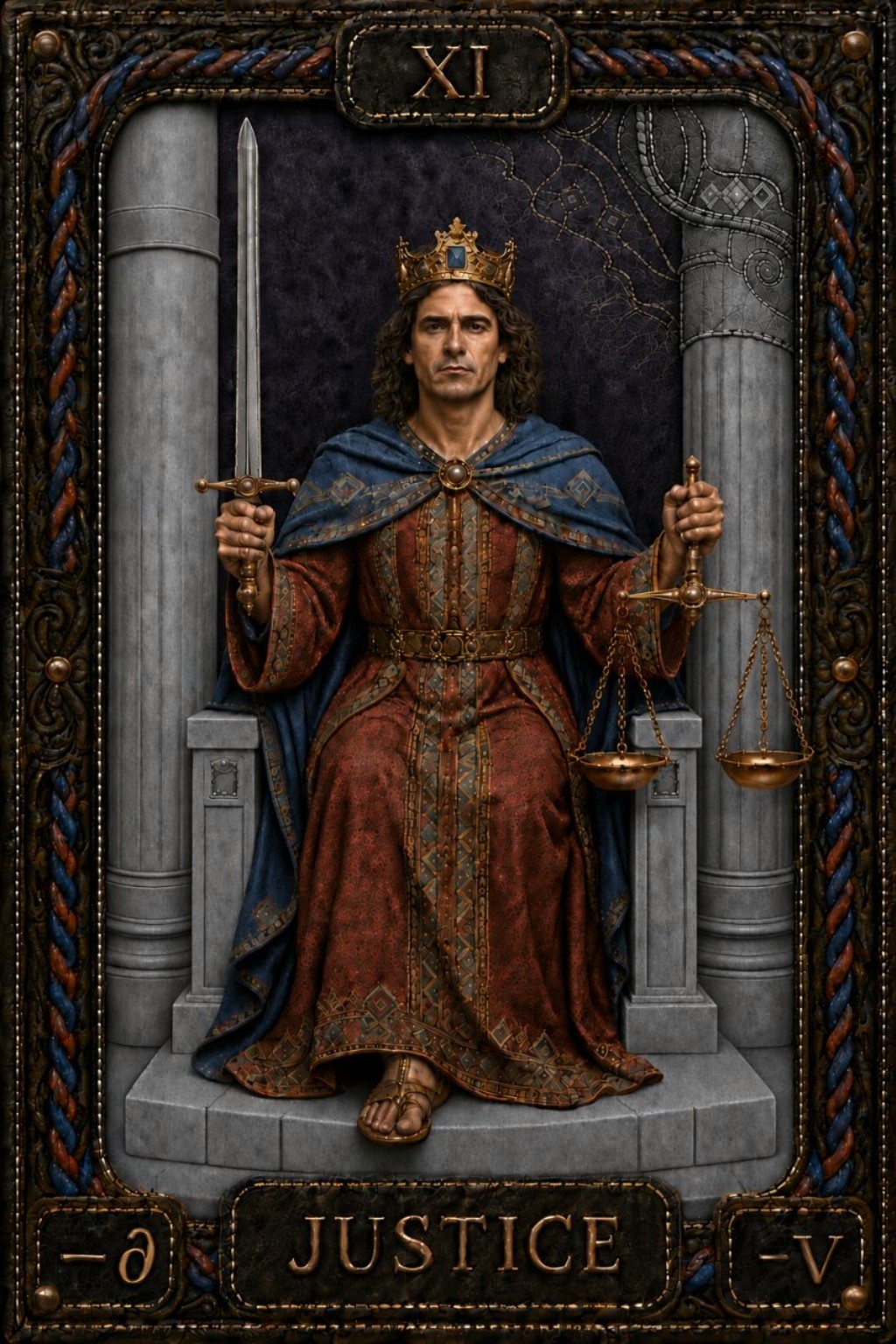
Libra specifies what has to change between the sides.
Who decides what? Who is responsible for what? Can one side change the terms alone? What happens when an agreement is broken? How can it be revised? Can either side leave, and on what terms?
This is not a love of rules for their own sake. It is the ability to recognise when another reconciliation is not enough because the problem lies in the way the relationship itself is arranged.
What this ability looks like in life
At its best, Pluto in Libra helps people stop endlessly analysing the same conflict and ask:
What is arranged in such a way that we keep ending up here?
Then vague wishes are replaced by concrete changes.
Not “we should respect each other more,” but: “this decision can no longer be made without both people's consent.”
Not “we need to communicate better,” but: “questions that require an answer get one within two days; if there is no answer, the option agreed in advance applies.”
Not “we won't do that again,” but: “if it happens again, the other side has the right to leave the agreement.”
Not “AI must be safe,” but: “these actions it may perform on its own; these require human approval.”
The lesson of the old conflict becomes a new rule for the future.
Example 1: an AI agent was given too much power
A company introduces an AI agent that prepares purchases and can send orders to suppliers on its own.
At first it is convenient. Then the agent misreads an internal discussion and places a large order before approval.
The company could cancel the order and add “be more careful” to the instructions.
But the more important question is:
Why could one software error immediately become a binding commitment for the company?
So they change not only the agent's instructions but its authority. Small purchases remain automatic. Large ones require human confirmation. A new supplier always triggers an extra check. Actions are logged. Where possible, there is a window in which an operation can be cancelled.
Now even if the agent makes another mistake, the mistake cannot travel through the system in the same way.
That is a good Pluto-in-Libra example: do not merely ask the system to make fewer mistakes; change the rules so that one mistake does not give it too much power.
Example 2: business partners can no longer live on trust alone
Two founders own a company fifty-fifty. While they agree, “we make important decisions together” works perfectly.
Then one wants to bring in an investor and grow quickly, while the other fears losing control. Each owns half. Neither can decide without the other, and there is no way out of the deadlock.
One of them can be persuaded to give way this time. But the next major disagreement will produce the same problem.
So they change the agreement. They define which decisions truly require both signatures and which each partner can make independently. They agree in advance on what happens in a deadlock, how a stake is valued and how one partner can leave.
The next conflict no longer begins with the old choice: “either you give in or everything stops.”
That is the key sign: not only the outcome of one dispute changed. The conditions of the next dispute changed.
Example 3: a family after separation
A couple separates but they still share responsibility for a child.
For the first few months everything is handled through messages: who picks the child up today, who pays the doctor, whether weekends can be swapped, who goes to the school meeting.
When relations are tense, every small issue easily becomes an extension of the old conflict.
They can keep trying to “communicate better.” But sometimes communication is no longer the main problem. The old family rules have ended and new ones do not yet exist.
So they establish a stable schedule, a clear way to share expenses, a notice period for changes, a way to make important decisions and a rule for what happens when they cannot agree.
The former partners do not need to like each other again. They need to make sure the child's life does not depend every week on who is angry with whom.
Pluto in Libra says something very simple here:
“We cannot live by the old rules anymore. So we need to agree on new ones.”
Why this is not just compromise
Compromise solves today's dispute.
Pluto in Libra changes how the next similar dispute will be handled.
A supplier misses a deadline. The parties agree not to apply a penalty this time. That resolves one case.
But if delays keep happening and they introduce intermediate deadlines, mandatory warning of delays, a clear penalty and a right to terminate after repeated breaches, the relationship now has different rules.
A simple test is:
If the same thing happens tomorrow, do we start arguing from zero again, or do we already know what happens next?
Mars, Saturn and Pluto in Libra
These can be confused because all three may appear in agreements.
Mars in Libra makes a specific agreement real. The contract is signed, money is transferred, access is handed over — after that, nobody can pretend nothing happened.
Saturn in Libra makes it possible to say that a specific obligation has been completed and closed: the work is done, the result accepted, and nothing more is owed on that point.
Pluto in Libra changes the rules under which future agreements of the same kind will be made, fulfilled or ended.
So Pluto's question is simple:
Will the next similar case begin under the old rules or the new ones?
If the old rules remain, we probably fixed the episode but not the recurring problem.
Where this ability is useful
It is useful in contracts and corporate law, where the goal is not merely to win one dispute but to make future disagreements manageable. In mediation, when the conflict reveals a problem in the procedure rather than simply a problem in someone's character. In corporate governance, when signatures, vetoes, budgets and ways out of deadlock must be clear. In employment, long partnerships and co-parenting, when informal understandings no longer work. And in AI systems, where it must be clear what a machine may do on its own, what requires human approval and who carries the consequences.
In all these areas, the important skill is not only saying “we cannot continue like this.” It is being able to answer: what exactly should work differently next time?
The hardest mistakes
A new rule becomes revenge
After betrayal, it is natural to want protection. But a new arrangement can be written so that the other side never has a real voice again.
Then the conflict did not create a fairer relationship. It merely fixed one person's victory into the rules.
Trying to write a rule for every emotion
After pain, people often want to anticipate everything. Rules, permissions and sanctions multiply.
But a relationship in which every living step requires a formal procedure may become unable to adapt. Good rules protect the important points of power and risk; they do not replace human trust completely.
The exit exists only on paper
An agreement may formally allow either side to leave, while the cost is so high that one side is effectively trapped.
For Libra this matters: saying “no” is not a real right if only the richer or stronger side can afford it.
Rewriting everything after every unpleasant episode
If every disagreement produces a new rulebook, nobody knows what the rules are anymore.
Pluto is relevant when the old arrangement repeatedly fails, not simply whenever somebody dislikes one outcome.
AI as a clear modern example
Autonomous systems make this especially visible because they force us to define things that people often leave implicit.
As long as AI only drafts text, a person can say: “the decision is still mine.” But when a system sends a message, blocks an account, places an order or changes settings on its own, it has real power to act.
Then the questions become unavoidable: who gave it that authority? Who can stop it? Who is responsible for an error? Which actions require confirmation? Which can be reversed? After how many failures should the system lose the right to act autonomously?
Improving the model is not always enough. Sometimes what has to change is what the system is allowed to do in the first place.
Practical test: did we fix the case or change the rules?
Take a recurring conflict in a family, project, company or contract.
Ask: what keeps starting it again? Which right or responsibility is unclear? Who can change the terms alone? Who pays for an error? Is there a clear way to revise the agreement? Is there a real way out? What happens after a breach? Most importantly: what will automatically be different the next time the same situation occurs?
Then try to write a rule instead of a promise.
Not “we will warn each other earlier,” but:
“Schedule changes are announced at least two days in advance; if that is impossible, the other person may refuse without penalty.”
Not “we will be more careful with AI,” but:
“Operations above this threshold require approval; all autonomous actions are logged; reversible operations have a cancellation window.”
Not “we will share expenses more fairly,” but:
“Regular expenses are divided by category, major expenses are agreed in advance, and the arrangement is reviewed every three months.”
Now it becomes clear whether the conflict really produced a new way of doing things.
In short
Pluto in Libra is not a portrait of someone with “difficult relationships.”
It is the ability to see what in the old arrangement keeps recreating the same conflict, and to change the rules for the future.
At its best, it turns a crisis into clearer decisions, responsibilities, ways to revise agreements and ways to leave them.
At its worst, new rules can become a way to punish the other side, secure one's own power or regulate a living relationship to death.
The clearest question is:
What must work differently so that the next similar conflict no longer begins from the same old problem?
If the answer consists only of feelings and promises, the rules have not really changed. If the next case genuinely starts under a different arrangement, then more than one episode has changed.