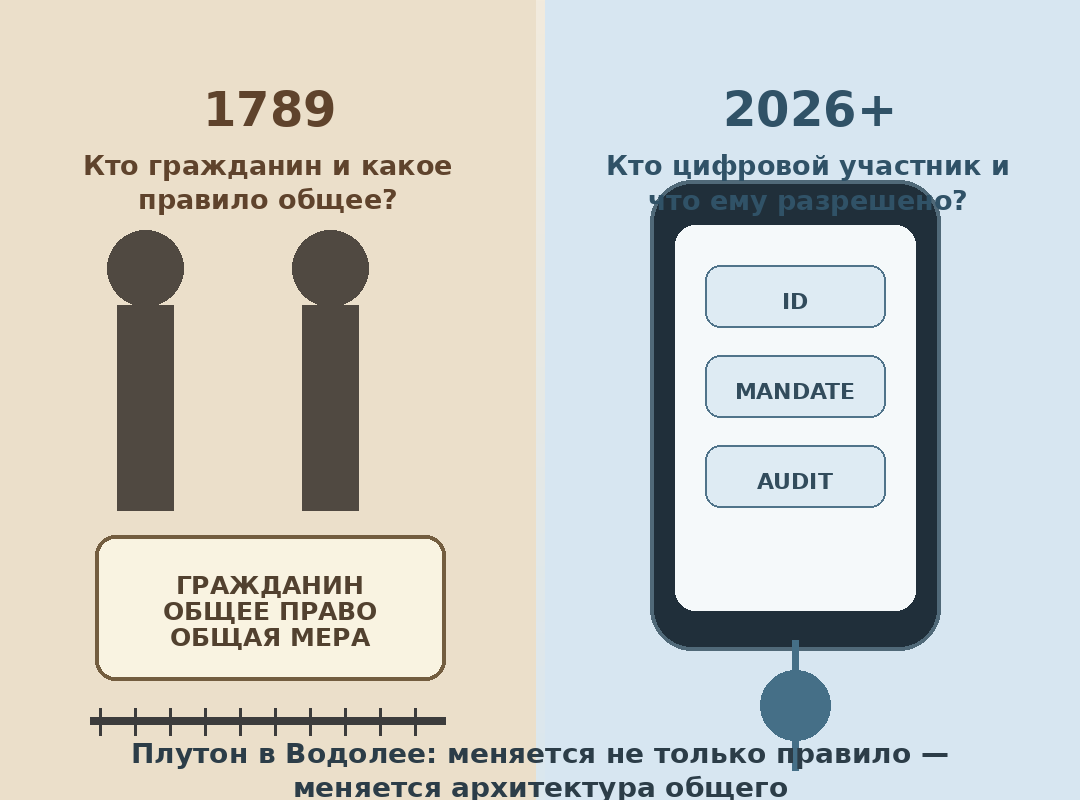
Think about 1789. In France, a person is increasingly described not only by estate or rank but as a citizen. Around the same time, local feet and measures begin giving way to a common metre. In the United States, winning independence is not enough; the new government needs rules defining how power is created, limited and changed.
Now move to 2026. If an AI agent found a seller, sent a request and prepared a purchase, who acted? Whose authority was used? Who is responsible? How can the agent's authority be revoked?
This is where Pluto in Aquarius becomes easier to understand.
What Pluto means in ordinary language
Pluto here is not a dramatic synonym for “transformation.” It appears when not just one outcome changes, but the rule by which the next similar cases will be handled.
After a conflict, two people can reconcile and fall into the same conflict again a month later. That changed an episode. Pluto begins when the arrangement itself changes: who decides, who is responsible, what is allowed and what happens after the next breach.
Pluto changes not one round of the game, but the rules under which the next rounds will be played.
What Aquarius adds
Aquarius concerns common rules that must work across many participants and cases.
So Pluto in Aquarius asks not only “which rule changed?” but:
Whom does the system recognise as a participant, what rights belong to that kind of participant, and who is allowed to change the common rules?
Historical example: citizen and common standard
Replacing one ruler with another is not enough if every following decision still follows the old logic.
A deeper change occurs when a new status — such as citizen — begins to determine voting, duties, protection and the relation between person and state.
The same is true of common measures. A metre matters not as a new ruler but as a shared way to compare many objects and transactions without depending on local custom.
Modern example: an AI agent
As long as AI only drafts text, the final external act still belongs to a human.
When an agent can send an order, spend within a limit or trigger another service, a new participant type appears.
Then “AI should be safe” is too vague. We need concrete answers: who granted authority, how is it verified, which actions are forbidden, who can inspect the action log, who carries responsibility for an error, and how can the mandate be revoked?
That is the Aquarian move: a private experiment becomes part of a common order.
From Capricorn to Aquarius
A Capricorn-like system tends to gather around a centre: a leader, institution, core task, budget or hierarchy.
Aquarius asks the next question: if there are many centres and participants, what lets them work together?
The answer is shared standards, protocols, credentials and compatibility rules. Instead of one boss deciding everything manually, different participants recognise one another through common conditions.
Why Uranus and Saturn matter
Aquarius is ruled by Uranus and Saturn.
Uranus notices that an old common rule is mixing different cases. A simple program and an agent with delegated authority to spend money should not be treated as the same type.
Saturn then draws a usable boundary: which signs are sufficient, which powers belong to which class, and where the rule ends.
The new distinction becomes a rule many systems can actually use.
Who may change the rules?
Any platform can publish a standard. But who is allowed to revise it?
If one platform decides who counts as a participant, changes the criteria and settles disputes by itself, a “common standard” may simply be private power with a neutral-looking label.
So the mature Pluto-in-Aquarius question is not only “what is the common rule?” but “who may rewrite the common rule, and by what procedure?”
Company example
A company may revolve around its founder for decades. Replacing the CEO changes little if the new person sits in the same position with the same powers.
The system changes more deeply when decisions are distributed differently: teams receive clear areas of responsibility, budgets and outcome criteria, and the founder is no longer the mandatory point of every decision.
Then the person at the centre did not merely change; the way a centre is produced changed.
The main mistake
A new law or policy can look like a profound change while changing nothing in practice.
Does the next similar case actually proceed differently, or do people still reproduce the old order?
If the new document exists only on paper, the system has not changed.
A practical test
- Whom does the system recognise as a participant?
- Which actions may that participant perform?
- Who is responsible for consequences?
- How is authority verified?
- How is authority revoked?
- Who may change the common standard, and by what procedure?
In short
Pluto in Aquarius is a change in the common order: not only a particular rule, but who counts as a participant, what rights are available, and how future similar cases will be handled.
The central question is practical: what must be arranged differently so that the next case can no longer automatically reproduce the old order?