Abstract
The Virgo–Pisces axis is usually described too narrowly: order versus chaos, analysis versus intuition, details versus the whole. Such a formula lists psychological associations but does not explain what operation each side performs, why these very operations are depicted in The Hermit and The Moon, or why Pisces needs two different rulers—Neptune and Jupiter.
In the generative model, the sign defines the geometry of the environment, the planet is the verb acting within that environment, and the card shows the resulting scene. We therefore need to distinguish three layers:
- Virgo defines an earthly local configuration;
- Mercury in Virgo acts as an Air operator of distinction;
- Pisces defines a continuous watery trajectory;
- Neptune changes the internal coordinate system of that trajectory;
- Jupiter expands its event scale and brings an internal possibility outward.
The Virgo–Pisces axis then ceases to be a dispute between “reason” and “feeling.” It becomes a cycle: change the map → open new routes → isolate a testable step → return the result to the living trajectory.
1. Not Personality Traits, but Operations on the Same Problem
The central question of the axis can be stated as follows:
How can the ocean be made distinguishable without destroying its depth, and how can the whole be preserved without allowing it to swallow every distinction?
Virgo and Pisces work on the same problem from opposite ends.
Virgo asks:
What exactly is happening here? Which distinction matters? What local fragment can be tested, corrected, or repeated?
Pisces asks:
What history brought the state here? In what broader map does this fragment acquire meaning? What will be lost if it is cut out of the trajectory?
Virgo therefore is not the same as “dry rationality,” and Pisces is not the same as “vague intuition.” Virgo creates local resolving power. Pisces preserves continuity of transformation.
The axis has two symmetrical errors.
- Without Pisces, Virgo mistakes a working criterion for the structure of the entire world. A filter becomes a tunnel, a diagnosis becomes an identity, and an instruction replaces a living process.
- Without Virgo, Pisces can place every new fact into yet another context but never allow the fact to decide anything. Everything can be explained, so nothing ever closes.
A healthy axis does not choose one side. It builds reversible feedback between them:
indistinguishable whole → local distinction → test → change in the map of the whole.
2. Four Geometries: What Boundary and Volume Mean
In the established canon of the project, the elements differ by two independent features:
Element |
Own boundary ∂ |
Preserved internal volume V |
Basic geometry |
Earth |
+ |
+ |
local form with its own contour and content |
Water |
− |
+ |
content is preserved but takes the boundary of the environment |
Fire |
+ |
− |
distinguishable “before/after” transition without a preserved interior |
Air |
− |
− |
relation, coordinate, or path without its own container or substance |
Here, volume is not physical size. It is the content that a system carries within itself and preserves through transformation. A boundary is not necessarily a wall. It is the system’s own way of separating inside from outside.
Earth is like a bowl with contents: both the form and what is inside it are locally defined.
Water is like a liquid: its amount and accumulated history are preserved, but its form is borrowed from a channel, vessel, body, or situation.
Fire is like an event: a flash, decision, rupture, or launch. An event has a boundary between “not yet happened” and “already happened,” but it has no stable internal volume.
Air is harder to understand because both of its features are negative. Yet this does not mean emptiness or unreality. Air is the reality of relations, and a relation can be extremely precise even though it contains no substance.
3. Air (-∂, -V) in Completely Everyday Examples
3.1. Negative Volume: the Sign Does Not Contain the Thing It Denotes
The word “cup” contains no porcelain, handle, weight, or coffee. An address does not contain a house. A formula does not contain a physical process. A spreadsheet filter does not store the selected objects as its own internal substance.
This is −V: an Air construction does not carry the material content of an object into itself. It carries a distinction, a name, a relation, a search rule, or a way of moving from one point to another.
This is precisely why the same criterion can be applied to different objects. The rule “more than seven days overdue” belongs to no particular invoice. It is materially empty, yet reproducible.
3.2. Negative Boundary: a Relation Does Not Form Its Own Territory
“Further left,” “earlier,” “similar to,” “replied to,” and “a cause of” exist only between elements. You cannot draw a wall around a relation and place objects inside it. The relation stretches through the objects it connects.
This is −∂: Air does not build its own container. Its “boundary” arises as a condition of distinction.
For example, the query:
red cup on the second shelf from the left
does not build a physical wall around the cup. It excludes every object that fails the relations “red,” “cup,” “on the second shelf,” and “from the left.” The object is localized not because we constructed a new container, but because the network of relations left only one matching option.
3.3. Two Minuses Together: an Empty but Precise Tool
The Air operator:
- stores nothing inside itself;
- does not own a region of space;
- yet makes it possible to find, connect, compare, translate, or exclude.
A good everyday image of Air is therefore not an empty room but an address, index, query, coordinate grid, filter condition, or transition instruction.
Air does not say, “Here is my thing.”
It says:
“Here are the relations by which the thing you need can be distinguished from the rest.”
3.4. What It Means to Say “Mercury Introduces a Transferable Criterion of Distinction”
The phrase sounds technical, but its meaning is simple.
A criterion of distinction is a rule that lets us say: “this belongs to the phenomenon we are interested in, and this no longer does.”
Transferable means that the rule is not tied to one particular object or one particular case. It can be taken and applied elsewhere.
Imagine ten cups. Earth deals with ten separate objects. But Mercury can introduce a criterion:
“Set aside every cup whose capacity is less than 200 ml.”
Mercury adds nothing to the cups themselves, does not change their form, and does not build walls around them. Yet once a single rule is introduced, the space immediately divides: these cups satisfy the condition, those do not. The same rule can then be applied tomorrow to completely different cups.
That is a transferable criterion.
Why is this -V? Because for the rule “capacity less than 200 ml” we do not need to preserve the whole cup: its color, purchase history, owner, contents, and other properties. Mercury keeps only the coordinate that matters for the present distinction.
Why is this -∂? Because a red cup is not separated from a blue one by a physical wall. The boundary arises functionally from the condition. Today we divide cups by capacity, tomorrow by material, the day after by whether they have a handle. The same object falls on different sides of the boundary depending on the selected coordinate.
Air therefore does not so much build territory as recombine distinctions. Its question is:
“What relation will let us distinguish what is needed from what is not, without carrying the whole object with us?”
4. Why Mercury Is Necessary to Virgo
Here it is especially important not to confuse the sign with its ruler.
In
the geometry of the project, Virgo remains an Earth environment: we
have a local configuration, a concrete body, object, task, or work
area. But within this earthly form Mercury acts as an Air function
(-∂, -V).
Earth is responsible for what exists as a separate object. Mercury is responsible for the distinction by which that object becomes accessible to analysis and action.
If we keep only Earth, we get a thing but not necessarily a way to understand what matters in it. If we keep only Air, we get a network of distinctions without an object to repair. The Hermit arises from their conjunction:
stable local form + immaterial criterion of distinction.
Mercury in Virgo does not fill the object with new content and does not build another wall around it. It creates a minimally sufficient description.

Formally, this can be written as:
M_Virgo(X, c) = the local fragment of X selected by criterion c.
Criterion c is not itself part of the material volume of X. It can be transferred to another object. Its boundary arises through the exclusion of what is irrelevant.
Four Simple Examples of Mercury in Virgo
1. Repair. The phrase “the faucet isn’t working properly” does not yet provide an actionable object. Mercury asks for specifics: is it leaking from the spout or from a joint, only with hot water or always, continuously or after the tap is closed? It adds no new substance to the water or faucet. It creates distinctions that localize the fault.
2. Conversation. The phrase “you didn’t support me” carries real emotional volume but contains no testable criterion. Mercury in Virgo asks: “Did you expect the person to agree with you, answer you, help through an action, or simply stay nearby?” One vague accusation becomes several different requests.
3. Software bug. The report “the program sometimes crashes” is replaced by a minimal reproducible scenario: version, input data, a sequence of three actions, expected result, and actual result. Mercury does not create the bug and does not store the program inside the description. It separates the causally meaningful difference from noise.
4. Research. Instead of “the model seems to predict the market,” one specifies a fixed target, the time at which a feature becomes available, no-lookahead, a control period, and a criterion for rejecting the hypothesis. Mercury in Virgo turns an impression into a testable procedure.
In all four cases, the operation is the same:
large context → distinguishable alternatives → local criterion → next testable step.
4.1. Why This Matters Especially in Virgo
Virgo is Earth (+∂, +V). Its task is the opposite of airy abstraction: to obtain a concrete, local, testable result. Mercury in Virgo therefore works in a very characteristic way:
to isolate from a complex situation one feature that can be tested here and now.
Suppose someone says, “My computer freezes strangely from time to time.” This is still too indeterminate. Mercury starts separating possibilities: does only one application freeze or the entire system; does it happen under load or at rest; is it related to temperature; can it be reproduced after the same sequence of actions?
Eventually a criterion appears:
“The freeze occurs every time after a second monitor is connected and the computer wakes from sleep.”
Now Virgo has a localized object of work. From the huge cloud of “something is wrong with the computer” a small testable distinction has emerged. We can connect the monitor, put the computer to sleep, wake it, and see whether the error is reproduced.
This is Mercury working inside the geometry of Virgo.
An even more everyday example: someone says, “I feel bad after certain foods.” Mercury does not dispute the experience itself but introduces distinctions: dairy or any fatty food; immediately after eating or three hours later; does it depend on quantity; does it occur after one particular ingredient? Instead of the indeterminate “food somehow affects how I feel,” a testable formulation appears: “the symptom occurs 30–60 minutes after foods containing X and does not occur with the same dishes without X.”
Such a criterion is transferable: it can be tested with other foods, on another day, and in another context. In this sense the Hermit’s lantern is very exact: it illuminates not the whole world but a small region of sufficient certainty.
Mercury in Virgo answers the question:
“Which distinction is genuinely informative right now?”
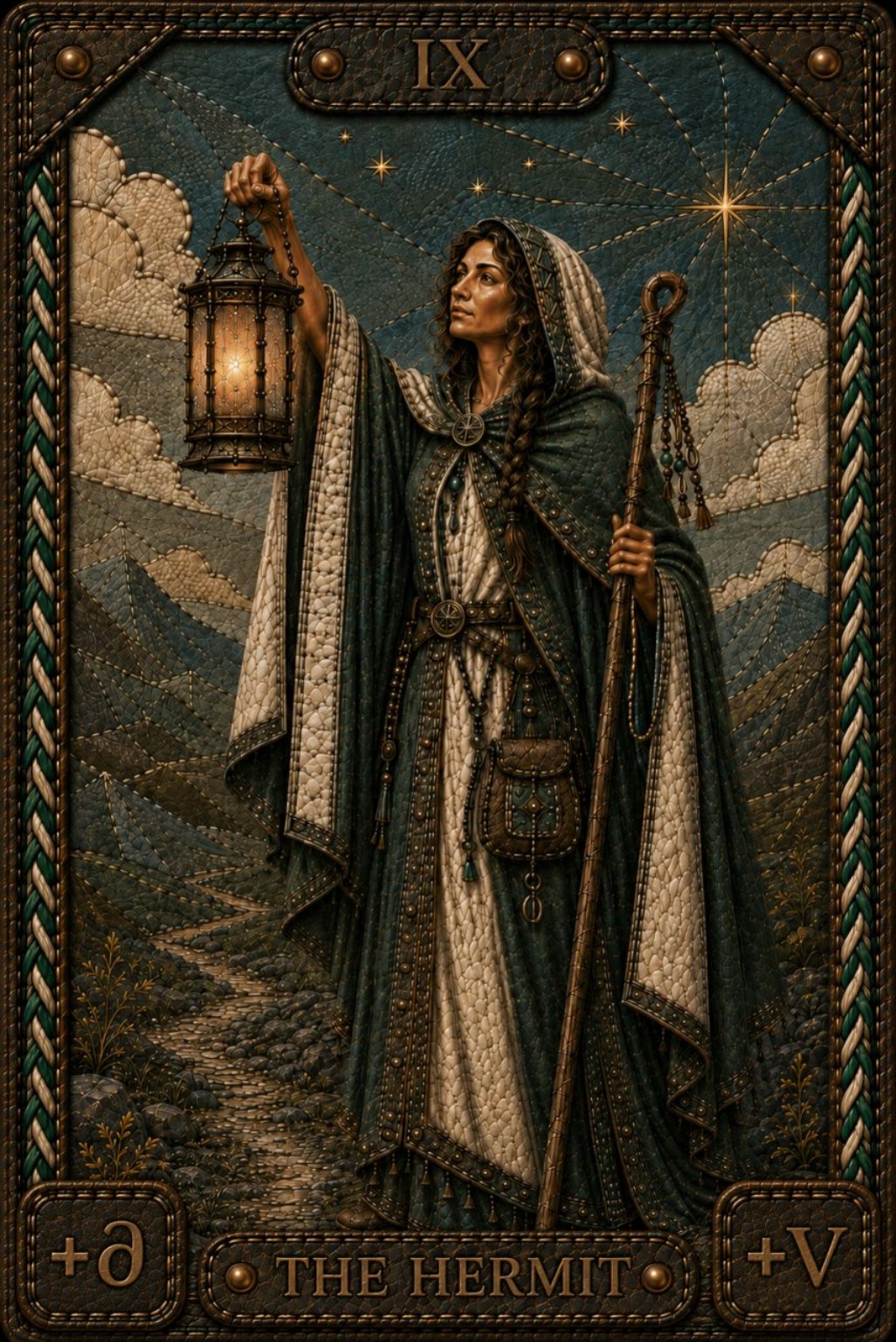
5. The Geometry of The Hermit: Earthly Form under an Airy Beam
The Hermit is not merely an image of solitude or a portrait of someone who “thinks a lot.” The composition of the card shows how Mercury acts within Virgo.

5.1. The Lantern: Local, Not Total, Visibility
The lantern does not illuminate the whole world. It creates a small working radius within which the next stretch can be distinguished.
This is an exact image of Air’s negative boundary. The circle of light is not a physical wall. Everything beyond it continues to exist, but it is temporarily excluded from the current operation.
The lantern does not claim:
“There is nothing beyond the light.”
It claims:
“For this step, it is enough to distinguish this area.”
This is how a scientific experiment, a diagnostic test, a clarifying question, and a minimal reproducible example work.
5.2. The Staff: a Transferable Coordinate
The staff establishes a vertical, a support, and the distance to the next step. It is not a burden or a stock of substance, but a local reference system.
The Mercurial function of the staff is that positions become comparable: stable here, unstable there; this step has been made, the next one has not yet been made.
5.3. Cloak and Figure: a Small Earthly Container
The body, cloak, and stable posture provide a positive earthly boundary. The Hermit has a localized bearer of the operation. The figure is not dissolved into the landscape or distributed among many figures.
It would therefore be a mistake to assign both airy minuses to Virgo itself. We would then lose what makes the card earthly: a separate figure, its own support, a stable position, and a concrete region of space. Air here belongs to Mercury’s function; it does not replace the Earth geometry of the sign.
5.4. Mountain and Darkness: the Context Is Not Destroyed
The Hermit is not in a void. Beyond the local light remains an immense, unexplored background. The card does not promise final knowledge. It shows the proper scale of the operation: one step, one criterion, one area of local restoration (healing) without requiring that it spread through the entire system.
This agrees with an earlier formulation of the project: for The Hermit we expect brief local reorganizations, separation of one step without a necessary cascade, filtering of weak disturbances, and dependence of the result on the depth of the higher-order domain.
5.5. Healthy Form and Shadow
A healthy Hermit knows that the light is local. The Hermit can formulate a criterion, test it, and return the result to a broader context.
The shadow begins when a local filter is declared to be the complete map of the world. A person refines details endlessly but does not allow the overall trajectory to change, or cuts away everything that does not fit the current classification.
6. Pisces and The Moon: Not an Absence of Form, but Preservation of a Trajectory
Pisces belongs to Water: (-∂, +V).
Water has no immutable boundary of its own. It takes the form of a channel, vessel, body, relationship, or historical period. But this does not mean that Water preserves nothing. It preserves volume, accumulated state, the memory of the path, and the inertia of previous influences.
The question of Water therefore differs from the question of Earth.
Earth asks:
What is being held now?
Water asks:
How did the state arrive here, and where is its already accumulated trajectory carrying it?
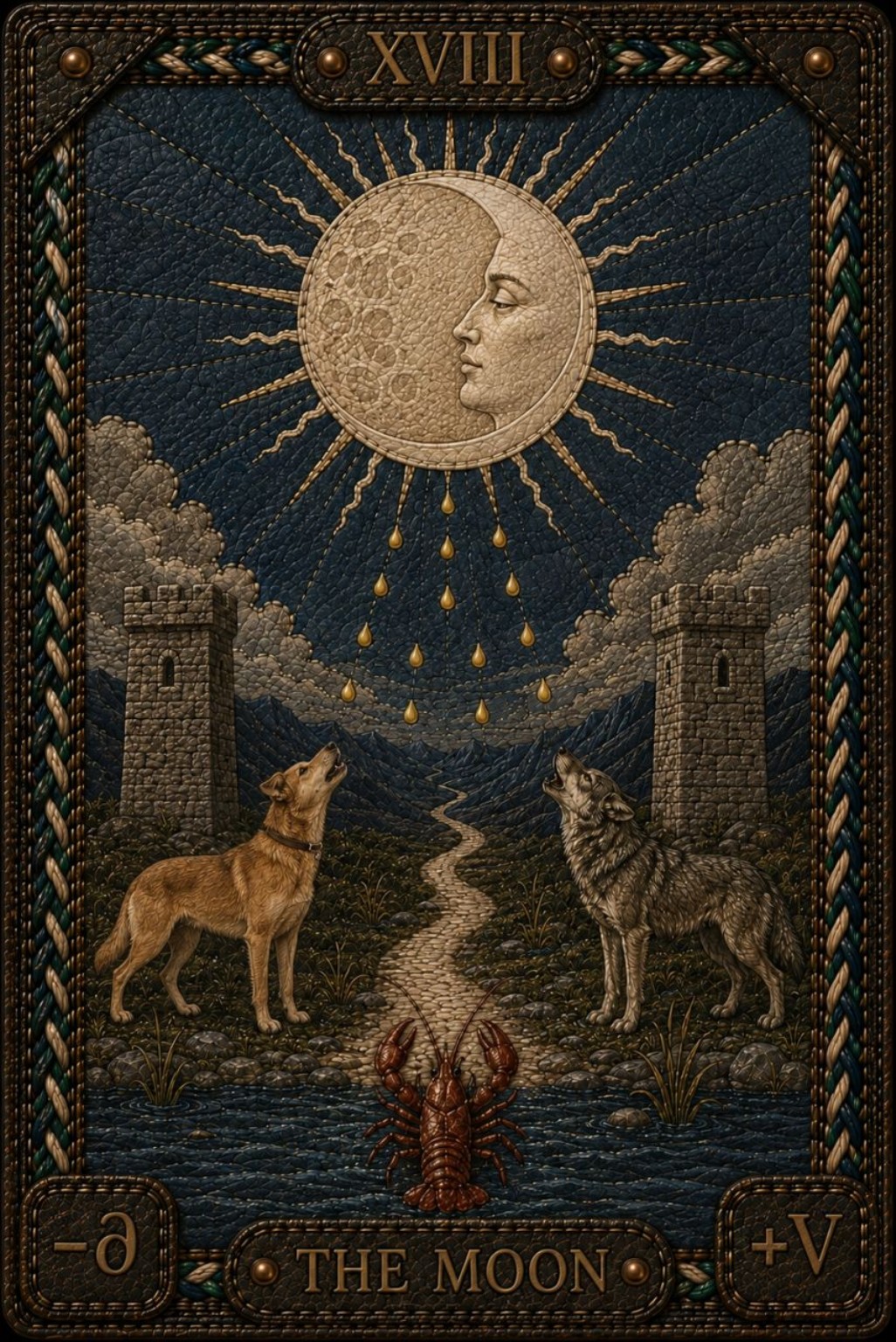
The Moon is not a card of “illusion in general,” but of a world in which the current point cannot be understood apart from the path, the environment, and what came before.
7. The Geometry of The Moon

7.1. Moonlight: Distributed and Reflected Visibility
The Hermit’s lantern belongs to a figure and can be directed. Moonlight belongs to no one. It is distributed across the whole scene and changes the visibility of all objects at once.
This is the first fundamental opposition between the cards:
- The Hermit carries a local source of distinction;
- The Moon places the observer inside a shared perceptual environment.
Moonlight does not necessarily lie. But it does not provide an independent, final position for the observer. Contours are visible, while internal content remains dependent on phase, distance, and environment.
7.2. The Two Towers: Boundaries Exist, but They Do Not Close the World
The towers create a threshold and a local corridor. Yet they do not form a closed container. The road passes between them and continues beyond.
This is an exact image of a watery boundary: form is temporarily given by the environment, but the trajectory is not exhausted by that form.
The towers can be understood as two known modes, two former identities, or two systems of rules. The path does not have to destroy them, but it does not end inside them either.
7.3. The Road: the Main Invariant of the Card
There is no single central object on the card that contains the meaning of the scene. Meaning is distributed along the route: water, shore, animals, gateway, ascent, horizon.
The road ties heterogeneous forms into one story. It is the trajectory, not any single object, that preserves the identity of the process.
7.4. Water: Accumulated State
The water at the bottom of the card is not merely “the unconscious” as a ready-made label. It is the area in which previous influences have already been integrated but have not yet been translated into a local distinction.
Water carries more than one criterion can illuminate at once. Pisces therefore needs The Hermit, but cannot be exhausted by its lantern.
7.5. The Crayfish: Content Slowly Emerging from an Old Environment
The crayfish appears at the boundary between water and land. It carries its previous shell into a new space. This is a good image of a transition in which inner content has already begun to move outward, while the mode of movement still preserves the history of the old environment.
A new form does not appear from nothing. It carries a trace of the water onto land.
7.6. Dog and Wolf: One Impulse in Two Boundary Regimes
The domestic and wild animals can be read not as a moral pair but as two forms of the same force: one already included in human order and one that remains outside it.
The card shows that the same signal can take different forms depending on the boundary of the environment. For Water, the important thing is not choosing the “right” animal but preserving the common impulse while its envelope changes.
7.7. The Horizon: the Local Scene Does Not Close the Process
The path continues beyond the visible stretch. This is not a promise of endless uncertainty, but an indication of scale: the present configuration is only one phase of a longer history.
8. Why Pisces Has Two Rulers and Why They Do Different Things
In this model, the major and minor rulers are not “strong” and “weak” versions of the same function.
The major ruler determines how the coordinate system itself is reorganized: what counts as the same object, where the observer is located, and which boundaries cease to be primary.
The minor ruler changes the dynamics inside an already transformed space: the scale of possibilities, the number of available routes, the phase, and the emergence into an event.
For Pisces:
- Neptune / The Hanged Man — the major operator that changes the map;
- Jupiter / Wheel of Fortune — the minor operator that expands eventfulness and the scale of routes.
In the language of the elements, the difference is especially clear. Neptune is Water acting within Water: it changes borrowed boundaries while preserving the inner core and continuity of experience. Its operation therefore constitutes the Piscean environment itself. Jupiter is Fire acting within Water: it introduces a phase, a turn, and the “before/after” boundary of an event. It does not create the depth of Pisces; it forces that depth to move into a new event-position.
In short:
Neptune changes the space in which the path is sought. Jupiter increases the number and scale of paths within the new space.
9. Neptune and The Hanged Man: When the Problem Is Not the Path but the Map
The key question of The Hanged Man is:
What if the problem is not the path, but the map itself?
Neptune is not activated every time life becomes difficult. It is needed where the direct path is blocked because the problem itself has been framed incorrectly.

9.1. The Full Neptune Operator
Input: a value or need is preserved, but its habitual form of realization has become impossible.
Transformation:
stop futile action → live through the impossibility → separate the value from its old form → change the internal map.
Output: an indirect or new path appears in which the core value is preserved, while the former shell is no longer treated as the only possible one.
Healthy form: accept a real limitation without abandoning the value itself; allow the old way of realizing it to die.
Shadow: suspension, passive waiting, repetition of the impossible, calling inactivity “depth,” endless dissolution of a map that has already taken shape.
The Hanged Man is a boundary zone: the old path no longer works, while the new one has not yet formed. It should therefore be confused neither with simple renunciation nor with a ready-made solution.
9.2. What Exactly Neptune Does inside The Moon
The Moon shows an entire environment filled with ambiguous objects. Neptune explains why there is no final external point of observation within this environment.
It brings the external inward: an event ceases to be merely a fact of the world and becomes part of an internal map, image, state, or memory. What changes is not one object but the relations among all objects.
Formally:
N: (situation X, coordinate system C₀) → (the same situation X, a new coordinate system C₁).
The facts may remain the same, but what counts as cause, obstacle, value, and possible path can change.
The Hanged Man depicts the moment of changing coordinates. The Moon depicts a world in which no local coordinate can any longer be treated as absolute.
9.3. What It Means to Say “Neptune Changes the Coordinate System”
Imagine an ordinary geographic map. On it you can move north, south, left, or right. As long as we remain on that map, every change takes place within an already given coordinate system.
But sometimes the problem is not that we chose the wrong point on the map. The problem is the map itself. Neptune then does not say, “move from point A to point B,” but:
“Perhaps you have defined the coordinates themselves incorrectly.”
This is why Neptune’s card is The Hanged Man. The person is not merely looking in another direction. The familiar relations “up—down,” “movement—stasis,” and “success—failure” temporarily cease to be self-evident. The world is viewed from another frame of reference.
Conflict example. For months, a person tries to answer the question “Which of us is right?” Every event is placed along a single coordinate: I am right ←→ the other person is right. One can collect a hundred new arguments and still remain inside the same system. A Neptunian shift occurs when the question changes: “Why do we need to establish again and again which of us is right?” Events are now organized not by the coordinate of correctness but, for example, by the coordinate of how the relationship itself is being constructed. The same episodes begin to mean something different.
Work example. A person asks, “How can I make myself work more effectively in this position?” The person is inside the coordinate low effectiveness ←→ high effectiveness. Schedules and productivity apps can be changed endlessly. But one day another question appears: “Why do I assume that my task is to remain in this particular job at any cost?” A new coordinate emerges: what does this activity sustain in me, and what does it destroy? The old facts have not changed, but their position within psychological space has.
That is what a change of coordinate system means: what changes is not necessarily an event in the past, but the way events are connected to one another.
Why is Neptune especially powerful in Pisces? Pisces is Water (-∂, +V): content is preserved, while rigid boundaries between its parts are weakened. Memories, feelings, images, and associations do not disappear; what changes is their connectivity. What yesterday belonged to the category “failure” may tomorrow enter the story as a necessary transition. The fact itself is preserved—the topology of meaning changes.
The major function of Neptune in Pisces can therefore be formulated as follows:
When the old system of distinctions no longer allows the path to continue, Neptune temporarily weakens it and allows preserved experience to be organized according to new coordinates.
9.4. When Dissolution Becomes Pathological
As long as the old map genuinely no longer works, dissolution frees the value from an impossible form. But if a new internal map has already taken shape and the person continues to destroy every emerging contour, Neptune ceases to be a transition and becomes a defense against the next phase.
Signs of such getting stuck include:
- every decision is declared “too superficial”;
- every criterion is dissolved by a new context;
- a new possibility is experienced but never tried;
- inaction is given an elevated explanation;
- therapy produces increasingly subtle interpretations but no new consequences.
At that point, what is needed is not “an even deeper Neptune,” but Jupiter.
10. Jupiter and Wheel of Fortune: Bringing the Internal Map into Event
If Neptune mainly brings the external inward and reworks it into a vision, state, or new map, Jupiter makes the opposite movement:
it brings the internal outward into eventfulness.
Wheel of Fortune changes the scale of the space of possibilities. It does not merely offer another thought. It moves the system into a phase in which different roles, encounters, routes, and consequences can arise.

10.1. Why Jupiter Is a Minor but Necessary Ruler of Pisces
Neptune constitutes the Piscean environment: it makes boundaries permeable and changes the internal map. But permeability alone does not create movement. Water can become an ocean without current or a swamp without an outlet.
Jupiter introduces a Fire function (+∂, -V) into Water: the turn of the Wheel creates a distinguishable event—“before” and “after”—without turning the event into a permanent container.
Within The Moon, Jupiter therefore governs:
- phase and cycle;
- the transition from an internal possibility to an external occurrence;
- the expansion of the radius of available routes;
- the appearance of the next stretch of the path;
- a change of position without destroying the entire system.
Neptune explains why the old road has ceased to be the only one. Jupiter makes the new map produce at least one new real route.
10.2. What a Phase Is and Why Pisces Needs It
The word phase means nothing mystical here. A phase answers the question:
“Where exactly are we within this process right now?”
The seasons form a continuous cycle, yet we distinguish the beginning of growth, maturity, decline, and rest. Nature does not flip a switch at midnight on September 1, but we can still say, “a transition from summer to autumn has occurred.” A continuous flow acquires distinguishable segments.
Jupiter does something similar with Piscean continuity. Water provides change of state; Jupiter allows us to say:
“One stage has ended here, and another has begun.”
Three related but non-identical concepts then appear.
A phase is a relatively stable way in which a process exists over some interval. For example: “I am still trying to preserve the relationship.”
A turn is the moment when the direction in which the process is organized changes. For example: “For the first time I stopped asking how to get the relationship back and asked why I cannot let it go.”
An event is the moment when the turn takes form in the real world. For example: the person cancels yet another attempt at reconciliation and begins organizing an independent life.
Schematically:
continuous flow → phase → turn → event.
Not every change of mood becomes an event. A state can fluctuate many times. A change becomes an event when the story is organized differently after it.
10.3. Why Wheel of Fortune Is an Exact Image of Phase Transition
The wheel is continuous: it has no natural absolute point at which “the old wheel ends and the new one begins.” Yet rotation produces positions—rising, summit, descent, lowest point, new rise. Continuous motion becomes a phase structure.
Jupiter therefore does not have to create the content of the process. Its function is to introduce direction into the flow:
“This is not simply another state. We have already entered the next segment of the story.”
10.4. Neptune and Jupiter Together: Two Examples
The end of a long relationship. At first the person thinks, “How can I get everything back?” Every fact is evaluated along the axis helps me get my partner back ←→ prevents me from getting my partner back. Neptune changes the map: “Perhaps I am trying to recover not the relationship itself, but the state of myself that existed inside it.” This is The Hanged Man: the coordinate system has changed, but action does not yet have to appear.
Jupiter introduces a phase: “This chapter is over. My task now is to build a life that is not organized around waiting for a return.” This then takes event form: moving house, a new routine, a new project, or a decision incompatible with waiting for the old situation to return. The Wheel appears here not as magical luck but as the movement of the story into another segment.
Learning and research. A person spends a long time reading, trying, making mistakes, and moving between disciplines. A Neptunian shift might sound like this: “I mistakenly thought I was choosing between physics and psychology; in fact I have been interested in one question all along—how to formalize the structure of subjective experience.” The old categories physics / psychology cease to be the principal coordinates.
Jupiter then says: “The next stage is to build my own model.” When the person writes an article, creates a research project, or publishes a book, the internal map acquires an event.
The distinction can therefore be stated very briefly:
Neptune changes the meaning of where we are. Jupiter turns this into a new “where next.”
10.5. Healthy Form and Shadow of Jupiter
A healthy Jupiter does not merely fantasize about options. It expands the space of action enough for the system to encounter a new fact.
Jupiter’s shadow is inflation of possibilities: endless plans, roles, contacts, and theories without selection; the belief that scale itself can substitute for precision; repeated turns of the Wheel without accumulating a result.
After Jupiter, Mercury in Virgo is needed again. Otherwise the new experience remains a vivid episode but never becomes a skill, criterion, or stable practice.
11. Neptune, Jupiter, and Mercury as a Sequence of Psychotherapeutic Technology
This sequence is especially clear in psychotherapy.
Stage 1. Neptune / The Hanged Man — Stop Solving the Problem within a Map That Does Not Work
The person discovers that habitual actions reproduce the same impossibility. The work is not to select a new technique immediately, but to stop the old compulsion, preserve the core value, and separate it from its habitual form.
Criterion for completing the stage: the old interpretation no longer monopolizes the meaning of the situation; the value can be named separately from the former way of obtaining it.
Stage 2. Jupiter / Wheel of Fortune — Create New Eventfulness
The new map must encounter the external world. Alternative forms of contact, new roles, environments, sequences of action, and real trials appear.
Criterion for completing the stage: there is not only a new explanation but also new consequences; at least one route has actually been lived rather than merely imagined.
Stage 3. Mercury in Virgo / The Hermit — Isolate the Mechanism That Works
From the many new impressions, what can be repeated is isolated. The trigger, action, observable result, and correction rule are defined.
Criterion for completing the stage: the person can say not only “I understand this differently now,” but also “in this situation I do this, watch this sign, and change my action if I get this result.”
Why We Cannot Stop at a Single Stage
- Neptune without Jupiter turns therapy into endless redescription.
- Jupiter without Mercury turns it into a collection of new experiences.
- Mercury without Neptune turns it into a checklist embedded in the old map.
- Mercury without Pisces can consolidate a locally effective action that damages the longer trajectory.
The complete cycle looks like this:
impossibility of the old path → change of map → new routes → local criterion → repeatable step → feedback to the whole trajectory.
12. One Complete Example: “I Am Not Supported”
The initial experience:
“The people close to me do not support me.”
This is a real accumulated volume of Water: many episodes, expectations, bodily reactions, and memories. It would be a mistake to call it “too vague” and discard it immediately.
Neptune
The old map may assume that if someone is close to you, they should automatically understand what kind of support is needed, and that asking for support makes it inauthentic. The problem then lies not only in the partner’s behavior but in the map of closeness itself.
The Hanged Man suspends the direct dispute “supports me / does not support me” and separates the value of closeness from a single form—being understood without words.
Jupiter
Other routes appear: ask to be listened to without advice; ask for a specific action; clarify timing; turn to another person; separate emotional from practical support.
This is no longer merely a new understanding. The internal map enters eventfulness.
Mercury in Virgo
Now a precise formulation is required:
“I do not need advice today. Stay with me for ten minutes and ask me one question about what happened.”
A criterion of observation also appears: was the request actually spoken or merely expected; did the person respond, refuse, offer another time, or change the subject?
The large watery experience has not been destroyed. It has become accessible through one local filter.
12.1. The Same Sequence in a Work Example
Take a person who says:
“I feel bad at work.”
This is still almost pure indeterminacy. At the Piscean layer there is a large inner cloud: fatigue, irritation, a sense of meaninglessness, fear of losing income, habit, relations with colleagues, former dreams, and a sense of duty. Everything is connected to everything.
Neptune / The Hanged Man. A new thought appears: “Perhaps my problem is not that I am doing this job badly. Perhaps I am still trying to conform to an image of myself that no longer fits me.” The coordinate system has changed.
Jupiter / Wheel of Fortune. The next conclusion is: “The stage of trying to become the ideal employee here is over. A stage of looking for a different form of work is beginning.” A new phase has appeared.
Virgo / The Hermit. Now we need to understand what exactly to do.
Mercury. It introduces testable distinctions: what exactly is exhausting—the type of tasks, amount of communication, lack of autonomy, schedule, or the field itself? After a week of observation it turns out: “On days of independent analytical work, my state is normal. Sharp exhaustion appears after days with four or more meetings.”
Here is the Mercurial transferable criterion:
number of intensive social switches → change of state.
It can be tested for another week, compared in another job, contrasted with vacation, and used when choosing the next position.
The whole axis in this example works as a single mechanism:
Pisces → Neptune → Jupiter → Virgo → Mercury.
In words:
first the complexity of experience is preserved → then the map changes → the next phase emerges from the new map → the phase is translated into a local task → a testable distinction is found for that task.
Pisces therefore asks: “What if the entire map is organized differently?” Neptune: “Look at it from another frame of reference.” Jupiter: “Which stage begins now?” Virgo: “What can be determined here and now?” And Mercury: “What is the smallest distinction that will let us test this and then apply it again?”
13. The Lantern and The Moon: a Visual Formula for the Entire Axis
Both cards are nocturnal. Both operate where complete visibility is absent. But they organize the unknown in different ways.
The Hermit / Virgo |
The Moon / Pisces |
transferable local light |
distributed reflected light |
one bearer of the criterion |
no privileged center |
staff as a local coordinate |
road as a long trajectory |
one next step |
sequence of phases and environments |
small working contour |
permeable, borrowed boundaries |
the question “what exactly?” |
the question “from what history, and where to?” |
risk of tunnel filtering |
risk of endless context |
The Hermit says:
“I do not have to illuminate the whole world in order to take the next precise step.”
The Moon replies:
“You cannot understand the next step if you forget the path and the light by which you arrived here.”
Their conjunction yields a mature formula:
illuminate exactly as much of the path as is needed for the step, then after the step check the whole trajectory again.

14. River, Swamp, and Dry Channel
A good image of the integration of Earth and Water is a river.
Water preserves volume and the history of movement. The banks create local direction. A river does not destroy water through a boundary; the boundary makes flow possible.
From this come three modes:
Pisces without Virgo is a swamp. There are many connections and much accumulated content, but no local gradient, no criterion of exit, and no next distinguishable step.
Virgo without Pisces is a dry channel. Structure, classification, and procedure remain without living content and without the ability to change under the influence of history.
Virgo together with Pisces is a river. Deep content receives a local path, while the path remains connected with its source and the direction of the flow.
Earlier materials formulated this task especially precisely:
Earth creates a local filter, well, or criterion that turns saturated internal content into something accessible and distinguishable. The question of the axis is: can the ocean become distinguishable?
15. Operational Signs of the Three Rulers in Conversation
Observable change |
Operator |
Geometric meaning |
“Perhaps we have framed the question itself incorrectly” |
Neptune / The Hanged Man |
change of coordinate system |
the original value separates from its habitual form |
Neptune / The Hanged Man |
dissolution of the old map while preserving the core |
genuinely different routes appear |
Jupiter / Wheel |
expansion of the event space |
an internal conclusion is tested by a new situation |
Jupiter / Wheel |
bringing the internal outward |
an ambiguous word is decomposed into alternatives |
Mercury in Virgo |
creation of local distinguishability |
a criterion for a successful next move is formulated |
Mercury in Virgo |
filter without its own volume |
after the result, the entire subsequent strategy changes |
integration of the axis |
the local test is returned to the trajectory |
This table matters more than a dictionary of archetypes. The same person can perform different operations in different episodes. Here, a planet is not a personality label but a verb of transformation.
16. What the Rulers Actually Do in the Geometry of the Cards
The Hermit / Virgo
Environment: Earth (+∂, +V) — a local object, its own support, a concrete area of work.
Ruler: Mercury / Air (-∂, -V) — a transferable criterion, relation, address, filter.
Result in the image: the figure and mountain provide a stable configuration; the lantern and staff create local resolving power. The card shows not the whole world but the minimally sufficient area for the next step.
The Moon / Pisces
Environment: Water (-∂, +V) — preserved history and internal volume under borrowed boundaries.
Major ruler: Neptune / The Hanged Man — reorganizes the coordinates of the entire scene, places the observer inside a changing map, separates the value from its old form.
Minor ruler: Jupiter / Wheel of Fortune — creates phase, turn, scale, and an external route; it prevents watery continuity from remaining motionless dissolution.
Result in the image: distributed light, a permeable threshold between the towers, the road, changes of environment, cyclicity, and horizon. The card shows not one object but the continuity of a path through changing envelopes.
17. Final Generative Formula
A card can be understood as the result of composing environment, operator, and task:
card = geometry of the sign + action of the ruler + type of transition.
For The Hermit:
Virgo Earth + Mercury Air → a local distinction suitable for action.
For The Moon:
Pisces Water + Neptune → change of the internal map;
Pisces Water + Jupiter → expansion and eventful continuation of the route.
The full cycle of the axis:
The Moon: preserve the continuity of experience
→ The Hanged Man: change a map that no longer works
→ Wheel of Fortune: open and live new routes
→ The Hermit: isolate the working criterion and the next step
→ The Moon: return the local result to the long trajectory.
The final formula of the axis is therefore not “analysis versus intuition,” but this:
Pisces preserves what cannot yet fit into a local description. Virgo turns it into one distinguishable, testable step. Neptune changes the map when the old path is impossible. Jupiter brings the new map into events. Mercury separates the working mechanism from everything that merely accompanied the change.
The Hermit does not drain the ocean. The Hermit draws from it exactly as much water as can be examined and transmitted without mistaking the cup for the whole ocean.
The Moon does not abolish the lantern. It reminds us that the illuminated step remains part of a path that began earlier and continues beyond the visible horizon.