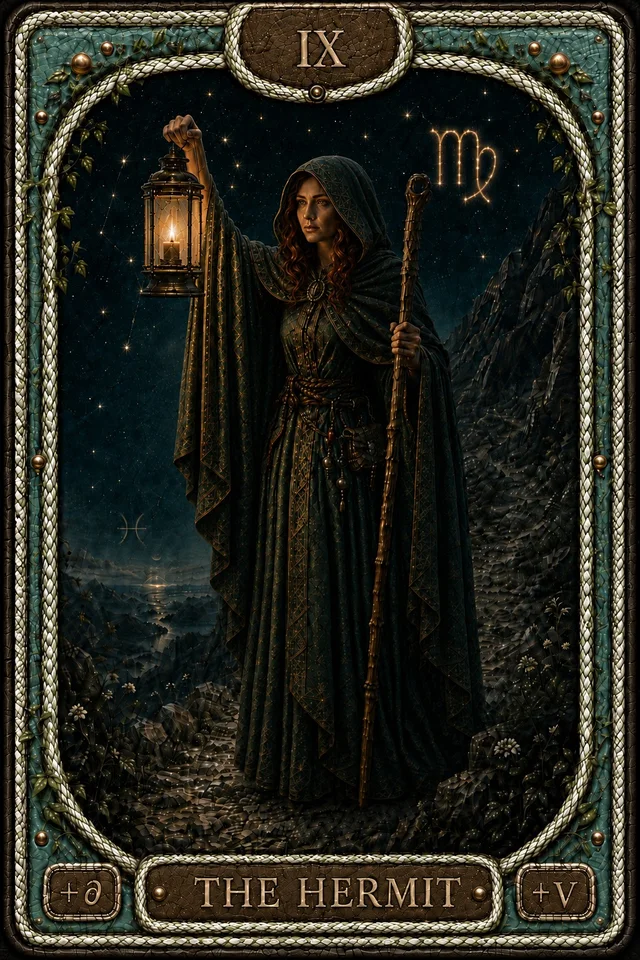
An archetype is easy to recognise in a picture. It is much harder to say what remains when the picture is removed.
First article in the series “From Image to Geometry”
Remove the labels from the doors
Imagine Europe around 1900. One person casts horoscopes. Another works in an occult order with Tarot, Kabbalah, letters, numbers and colour scales. A third studies hypnosis and unusual states of consciousness. A young Carl Jung observes mediumistic séances and later translates similar material from the language of spirits into the language of the psyche.
Today we quickly place them on different shelves: esotericism, occultism, psychology, science. Those labels do not answer the more interesting question:
How was each tradition trying to explain recurring human forms?
Some built dictionaries of images. Some built systems of correspondences. Others looked for psychological mechanisms. The approaches were sometimes closer than modern disciplinary labels suggest.
An archetype is not simply a type of person
Popular culture often turns archetypes into a quiz: you are the Explorer, Ruler, Magician, Hero or Caregiver.
A personality type asks: “Which class of people am I?”
An archetype in the stronger sense asks: “Which form keeps reappearing in very different stories?”
The Hermit, for example, need not mean “an introverted person.” It can describe a situation in which someone steps away from noise, narrows the field and checks one part of the path independently.
The same person may enter that pattern in one situation and not in another.
What existed before Jung
Jung was not the first person to notice that symbolic forms repeat. His important move was to turn that repetition into a psychological problem.
Long before analytical psychology, systems such as astrology already tried to explain variety through combinations of a limited set of elements rather than through an endless catalogue of types.
You do not have to accept planetary causation to notice the structural idea: many cases are generated by combining a few rules instead of inventing a new label for every person.
Why that is more interesting than a list of archetypes
Suppose a system says there is a Warrior because people fight, an Explorer because people search and a Ruler because people govern.
That can classify familiar images. A genuinely new case may simply require another archetype.
A combinational system asks something harder: can the new case be derived from elements we already have?
That does not make the system true. It does make it more testable because the rules can be applied to cases the author did not write in advance.
Nineteenth-century occultism as system building
Tarot was not born as a ready-made ancient psychological textbook. The cards moved from game culture into divination and later into mystical, artistic and political uses.
In the nineteenth century, writers such as Éliphas Lévi, MacGregor Mathers and members of the Golden Dawn tried to connect Tarot, astrology, Kabbalah, letters, numbers and colours into one network.
Many of those historical links are debatable. The intellectual task is still interesting: instead of interpreting every image separately, find a small number of coordinates that can explain many images.
What Jung changed
Jung made a decisive shift. The archetype became less an external symbol and more a way of talking about recurring forms of psychic life.
For Jung, the archetype is not simply a finished picture stored in the mind. Concrete images vary across cultures. What repeats is closer to an underlying form that receives different content.
That distinction is easily lost when archetypes become personality tests.
How the archetype became a quiz result
Popular psychology likes convenient profiles. “You are 62% Magician” is easier to consume than a discussion of the situations in which a particular pattern appears.
But convenience has a cost. The archetype starts looking like a permanent trait. Complex cultural images become lists of adjectives. And the system mostly says which known portrait a person resembles instead of explaining how a new case is produced.
Example: the Hermit
If the Hermit is a personality type, the description becomes something like independent, introverted, wise and cautious.
If the Hermit is a working form, the question changes:
Where do we need to step away from the general noise, narrow the field and check one concrete area with our own light?
That might be a scientist rechecking one result, an editor locating the exact sentence where meaning breaks, or a doctor isolating one decisive sign from ten symptoms.
The people are different. The structure of the situation is similar.
Why astrology becomes interesting again
Not as proven physics of celestial influence, but as an old attempt to build a combinational language.
If a planet is treated as an action, a sign as the conditions of that action, and a Tarot card as a visible scene, the question changes from “does this person resemble the description?” to:
Does the description follow from a small set of rules, and can those rules distinguish a fitting case from a non-fitting one?
The danger of recognising yourself too easily
People are excellent at recognising themselves in broad descriptions. “That is exactly me” is therefore weak evidence.
A stronger method is to describe a real situation first in ordinary language, then ask which model explains it and which models should reject it.
If a system fits everything, it explains nothing.
What makes a better model?
- Few independent rules. A new case should not require a new archetype every time.
- Derivation. The rules should generate a case that was not written in advance.
- Exclusion. The system should be able to say: “No, this similar-looking case does not belong here.”
Archetype as form, not label
The archetype becomes more interesting when it stops answering “who am I?” and starts asking:
Which structure of action is repeating here, regardless of who happens to be inside it?
Then the Magician, Hermit, Justice or Chariot do not have to be personality types. They can be visual models of different kinds of tasks.
In short
Archetype and personality type are not the same thing.
A personality type sorts people by resemblance. An archetype in the stronger sense looks for a recurring form that can appear in different people, cultures and situations.
The research question is whether a small set of such forms can generate new cases — while also making it clear where the model stops working.