Abstract
The Cancer–Capricorn axis is often reduced to the everyday opposition of “family versus career,” “emotions versus discipline,” or “softness versus hardness.” Such formulas are familiar, but they do little to explain the mechanism. Why does Cancer correspond to the Chariot—a card of movement and control—while Capricorn corresponds to the Devil—a card of dependency, hierarchy, and concentration? Why are Cancer’s rulers the Moon and the Sun, and Capricorn’s Saturn and Uranus? And why does a stable earth system need Uranus at all, a planet usually associated with the discovery of the new?
In the generative model, the sign defines the geometry of the environment, while the planet is the verb that acts within it. Cancer is Water (-∂,+V) directed toward changing another’s state: it creates an emotional flow, a shared rhythm, and an experience of belonging. Capricorn is Earth (+∂,+V) concentrated around a chosen object: it turns a priority into a hierarchy, a system, and a sustainable result.
The Moon, Cancer’s major ruler, inscribes the history of interactions into an internal state and habitual rhythm; the Sun, its minor ruler, provides a living source of influence in the here and now. Saturn, Capricorn’s major ruler, completes trajectories, selects the result that works, and turns it into a reproducible form; Uranus, its minor ruler, regularly checks whether that form has become a prison and whether an important possibility is missing from it.
The axis in brief: the Chariot provides the water for which the banks exist. The Devil builds the banks so that the water is not lost in a flood. The Moon makes the flow alive through its history, the Sun makes it alive in the present, Saturn makes it reproducible, and Uranus keeps it open-ended.
1. Not Feelings versus Duty, but Flow and Channel
The central question of the Cancer–Capricorn axis can be formulated as follows: how can experience be made shared and effective without turning it into a formless contagion of states, and how can a stable system be built without allowing it to forget what it was created for?
Cancer works with connection through state. It asks: what is happening between people right now? How do my tone, presence, distance, care, or anxiety change another person’s state? What makes a group “us,” a family a home, and a team a living team rather than merely a collection of job titles?
Capricorn works with connection through priority and form. It asks: what matters most here? Which resources must be subordinated to that goal? Which roles, rules, and constraints will make the result reproducible? What is the cost of leaving the system, and how will we know that it no longer serves its purpose?
Cancer without Capricorn therefore risks turning every intense state into shared weather: whoever is most anxious unwittingly sets the rhythm of the entire system. Capricorn without Cancer risks preserving the rules after their living reason has disappeared: the procedure is performed perfectly, but no one can say any longer whom it serves or why.
living
state → shared flow → priority → channel → result → check:
does the channel still serve the water?
2. Four Geometries: Why Water, Earth, Fire, and Air Are Needed Here
To understand the rulers, it is important not to confuse the geometry of a sign with the element of a planet. Cancer has a watery environment, yet one of its rulers is the Sun, a fire operator. Capricorn has an earthy environment, yet its minor ruler is Uranus, an air operator. This is not a contradiction: the environment defines the structure of the task, while the ruler defines the mode of action within it.
Element |
Boundary ∂ |
Volume V |
In plain language |
Earth |
+ |
+ |
has its own form and content that is preserved |
Water |
− |
+ |
content is preserved, but form is borrowed from the environment |
Fire |
+ |
− |
there is a distinct “before/after” act, but no stable internal container |
Air |
− |
− |
a relation, possibility, or coordinate without substance or territory of its own |
A boundary here does not necessarily mean a wall. It is a way of distinguishing “inside” from “outside.” Volume is not physical size, but the content that the system carries and preserves through change.
3. Cancer as the Water of Influence: What Is an “Emotional Flow”?
The statement “Cancer creates an emotional flow” may sound too abstract. Let us translate it into everyday language. An emotional flow is a sequence in which one signal changes another person’s state, and the altered state becomes the next signal.
For example, someone enters a room tense and answers curtly. Another person reads the coldness, becomes more guarded, and speaks more dryly. The first person takes this dryness as confirmation of distance and withdraws even further. No order was given, yet a flow has already arisen between them: state → signal → state → new signal.
The positive version works in the same way. One person speaks more calmly, sits nearby, and does not rush the answer. The other gradually relaxes and begins to speak in greater detail; this, in turn, makes the first person even more attentive. Cancer does not necessarily mean “emotionality.” It is the capacity to create and read this circulation of states.
3.1. What “Influence” Means
In the technical framework, this mode was called influence or power. In plain language, the operation is directed not only toward one’s own state but outward—toward the state of another person or of the shared environment.
The Emperor exerts influence through a command, a decision, or a direct act. The Chariot acts differently: through tone, proximity, atmosphere, rhythm, presence, distance, care, threat, and shared experience.
Thus, the words “everything is fine,” spoken calmly after ten years of reliability, and the same words spoken by someone who has lied many times exert different effects. The verbal content is identical; the watery history and state are different.
3.2. What a “Container of Belonging” Means without Psychological Fog
The word “container” often sounds mystical. Here it means something very concrete: a recurring organization of space, time, and responses within which the states of several people can coexist without falling apart at every change.
A Sunday family dinner is a container if it has a recognizable rhythm and offers a chance to be heard. A weekly team meeting is a container if people can genuinely report a problem and receive a response there. A chat is not a container in itself; it becomes one through a repeatable pattern of address and response.
A home, therefore, is more than walls. Walls belong to the earthy side. Cancerian “being at home” arises when the system recognizes your signals: here it is clear how to ask, how to step back, how to return, and what kind of silence does not cause the connection to disappear.
3.3. What Is a “Gradient”?
A gradient is a difference in state or significance that sets something in motion. Just as water flows from a higher level to a lower one, attention and emotional energy are often directed toward the place where anxiety, pain, joy, or need is most intense.
If one person at the table is visibly upset, the conversation gradually begins to revolve around them. If a manager enters a meeting visibly irritated, the team quickly adjusts the way it speaks even without an order. A gradient is not a judgment about “who matters more,” but a difference that gives direction to the flow.
4. The Geometry of the Chariot: How Different States Acquire a Shared Direction

4.1. The Two Animals: Difference Is Not Erased
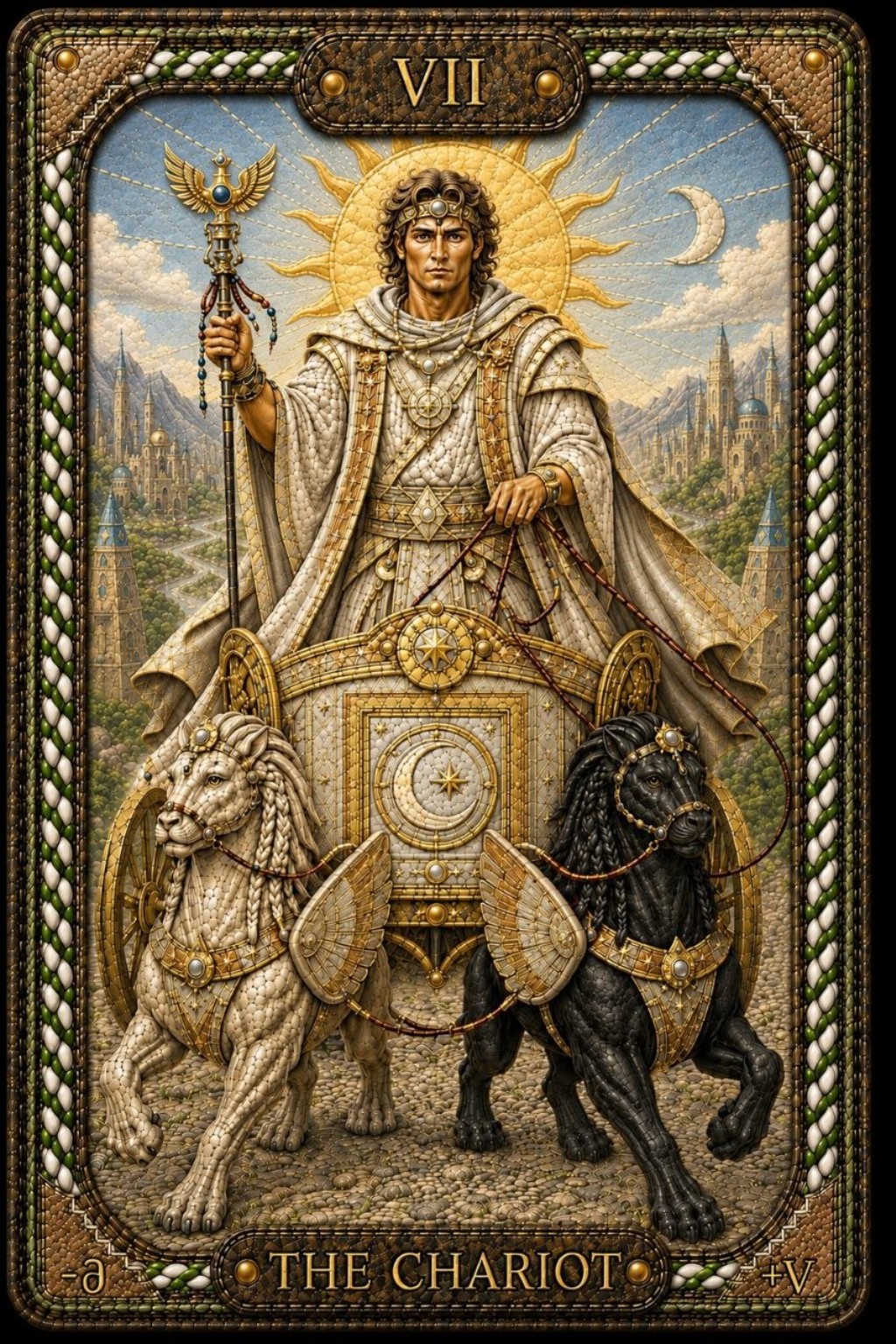
The white and black animals are more usefully read not as “good and evil,” but as two dissimilar impulses. They may have different tempos and motivations and may even pull in different directions. The Chariot does not require the difference to be erased. It creates a connection in which differences become part of a shared movement.
This is a precise image of a family, team, or couple: coordination does not mean identical feelings. One person may be anxious while the other remains calm; one wants to speak immediately while the other needs a pause. A shared channel exists when both states shape the manner of movement, yet neither has to absorb the other.
4.2. The Reins: Control through Feedback
The reins are a good image not of command but of sensitive feedback. Too much tension breaks the movement; no tension at all removes any shared direction. Cancerian control resembles continuous micro-adjustment: notice the state, change the tone or distance, observe the response, and adjust the next step.
Example: a child becomes nervous before a performance. The parent does not merely say, “Calm down.” Seeing that direct pressure increases the anxiety, the parent slows the pace, offers to go through the first two minutes together, and then steps back. This is not direct control of behavior; it is control of the conditions in which the state can change.
4.3. The Chariot’s Body: A Temporary Form for Water
At first glance, the chariot itself looks like an earthy container. But that does not make Cancer Earth. Water always needs a borrowed form: a vessel, a channel, a body, a ritual, a schedule. The Chariot depicts precisely such a form—it exists for the movement of the flow and can change with the route.
The difference from Capricorn is fundamental: for Cancer, form serves connection and state. For Capricorn, the stability of form, hierarchy, and result becomes a task in its own right.
4.4. The Charioteer and the Wand: A Living Source of Signal
The central figure sets the direction and sends a signal. In Cancer’s geometry, this connects particularly well with the minor Sun: within a shared emotional system, there must be someone or something that not only reflects the accumulated mood but also introduces a living impulse of its own.
The person who smiles first in a tense room does not “cancel” the shared state; they add a new source. A leader who, amid general alarm, calmly says, “First we will establish three facts, then we will decide,” creates a new emotional vector even before a formal procedure appears.
4.5. The City Behind and the Road Ahead: Belonging Must Be Able to Move
The Chariot leaves behind a city—an established order, a home, a familiar environment. Yet the card does not depict a motionless refuge. In this system, Cancer does not mean “hiding at home,” but carrying an internally accumulated rhythm outward and using it to move through a new situation.
Healthy belonging does not demand that one never leave the familiar. It provides a portable inner order: a person can leave home yet retain the ability to recognize safety, ask for help, create closeness, and respond to another’s state.
5. The Moon / The High Priestess—the Major Ruler of Cancer

The Moon’s major function is most simply expressed as follows: history becomes state. The past is not stored as a complete archive; it is compressed into habits of attention, bodily rhythms, expectations, ways of recognizing a situation quickly, and readiness for a particular response.
Why is this especially important for Cancer? Because an emotional flow never begins from zero. The same phrase, touch, or pause enters a system that is already tuned. The Moon explains why closeness consists not only of present words but also of the accumulated history of responses to them.
5.1. What It Means for “History to Be Inscribed into State”
Imagine two dogs. One has repeatedly been called calmly to its bowl; the other has previously been called in a similar tone before an unpleasant procedure. The same sound evokes different states not because the animals “remember a story,” but because past experience has already altered the body’s readiness to respond.
The same thing happens in humans at a more complex level. The message “we need to talk” triggers different reactions after a history of respectful conversations and after a history of sudden arguments. The Moon is not an archive of memories, but the way in which the archive has already become the system’s configuration.
5.2. Why the Moon Is Major Rather than Merely Supplementary
Without the Moon, Cancer would become a one-off emotional impulse. Warmth today would be warmth, coldness tomorrow would be coldness, but there would be no inner continuity between them. It is the Moon that creates an established order: the recurring expectation of how people usually respond here, what a pause means, who goes to whom, when one may step back, and how return takes place.
This is how the feeling of being “among one’s own” arises. It need not be sentimental. It is the predictability of emotional feedback shaped by history.
5.3. The Moon’s Shadow in Cancer: The Present Is Declared to Be the Past in Advance
Useful memory shortens response time. But it can also become a trap: a person stops checking the present because the inner order has already issued a ready-made forecast.

“He has gone silent, so he is about to reject me.” “The manager wrote a short message, so they must be unhappy.” “If I do not solve everyone’s problems, the family will fall apart.” In these cases, history ceases to support adaptation and begins to dictate the future.
6. The Sun—the Minor Ruler of Cancer: Why Water Needs a Source of Its Own
If the Moon explains how the past becomes the current configuration, the Sun answers a different question: what is manifesting in the system now from a center of its own, rather than merely as a reaction to the atmosphere already in place?
The Sun is a fire operator. Fire contains a distinct “before/after” act: someone began, spoke, appeared, illuminated, supported, or set a new tone. In Cancer, this does not turn Water into Fire; it gives the water a fresh source of movement.
6.1. Example: The Family Mood
Imagine a tired family. If everyone merely reflects everyone else, a closed loop forms: one person is irritated → another becomes colder → the first grows even more irritated. Here the Moon sustains the accumulated rhythm, but on its own it is not obliged to change it.
The solar function arises when someone introduces an impulse of their own: puts on music, suggests a walk, or cooks dinner not out of duty but because they want to change the state of the encounter. This does not guarantee success, but the system now contains a new source rather than yet another reflection.
6.2. Why the Sun Is Minor
One bright source is not enough to build belonging. A charismatic person may warm a room for an evening, but if responses become chaotic and unreliable again tomorrow, no stable order arises. The Sun is therefore important in Cancer, but secondary to the Moon: it animates the flow, while the Moon turns repetition into memory and rhythm.
The Moon asks: “How has history already configured us?” The Sun adds: “What living impulse are we bringing into that history now?”
7. Capricorn as the Earth of Object-Centered Concentration: What It Means to “Build a System around a Priority”
Capricorn is often described with the words “ambition,” “status,” “career,” and “discipline.” But these are consequences, not the mechanism. Geometrically, Capricorn is Earth (+∂,+V) in the mode of object-centered concentration. This means that one real priority is selected, and boundaries, roles, resources, and a criterion for the result are arranged around it.
For example, a family decides to save enough in one year to cover six months of living expenses. As long as this is merely a wish, there is no system. Capricorn begins when the priority changes the structure of decisions: part of the income is saved automatically, expenses are ranked, a threshold is established above which a purchase requires discussion, and a review date is set.
7.1. What Is a “Priority”?
A priority is not what we call important. It is what actually takes precedence when resources conflict.
If someone says health matters more than work but sacrifices sleep whenever it conflicts with a deadline, the current operational priority is work. Capricorn requires us to look not at declarations but at the allocation of time, money, attention, and acceptable losses.
7.2. What Is a “Hierarchy”—and Why It Does Not Necessarily Mean Power over People
Here, hierarchy means an order of priorities. What is protected first? What may be sacrificed next? Which task receives resources before another?
In a hospital, hierarchy may mean that a threat to life is addressed before comfort. In a project, it may mean that a critical bug is fixed before a cosmetic improvement. In a personal budget, it may mean that rent and food receive money before entertainment. This is a structure of choice, not a claim that one person is “worth more” than another.
7.3. What Is a “System”?
A system is not simply a large number of rules. It is an arrangement of roles, resources, constraints, and feedback capable of reproducing a result without the constant heroic effort of one person.
If a café survives only because its owner personally remembers everything and fixes every error, it is not yet a mature system. If purchasing, shifts, quality control, and the transfer of information continue to work in the owner’s absence, the form has become portable.
7.4. What Is an “Attractor” in Plain Language?
In technical language, the Devil is described as a strong attractor. An attractor is something to which a system returns again and again.
If rapid growth becomes a company’s chief priority, different decisions begin to organize themselves around this center: whom to hire, which product features to build, which risks to tolerate. If the safety of an ill relative becomes a family’s chief priority, schedules, money, and attention begin to revolve around that task.
An attractor is not “evil.” Danger arises when the center retains its power after the reason for it has disappeared, or when the system forbids examination of the priority itself.
8. The Geometry of the Devil: How Priority Becomes Architecture

8.1. The Central Figure: One Criterion Takes Precedence
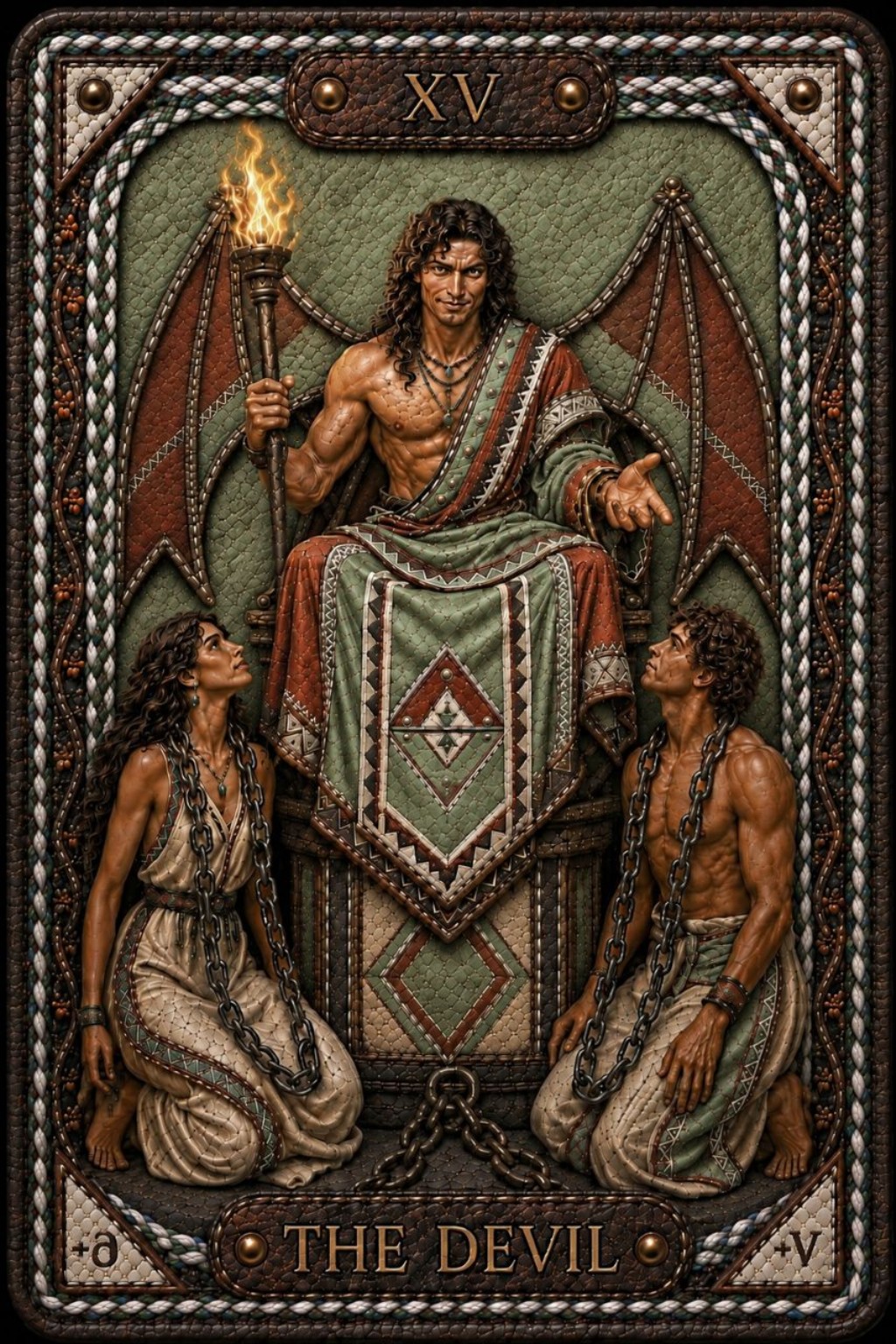
The main figure is positioned above the others and organizes the composition. This is what object-centered concentration looks like: one value, goal, role, or object becomes the center in relation to which the other elements acquire their positions.
It may be profit, a child, a scientific problem, a religious practice, an athletic result, a home, reputation, or safety. Capricorn does not say whether the chosen object is good or bad. It reveals the geometry: one center begins to redistribute everything else.
8.2. The Throne and Recurring Forms: Priority Has Become Infrastructure
The stable architecture around the central figure shows an important difference from a one-time decision. Capricorn does not merely choose a goal; it turns the choice into an environment that continues to act after the moment of choosing.
A single decision that “we are going to save” becomes automatic transfers and spending limits. A single decision that “quality matters more than speed” becomes testing, reviews, and release criteria. In this way, the priority ceases to depend on moment-to-moment willpower.
8.3. The Chains: What Is the “Cost of Exit”?
The chains are usually read exclusively as slavery. In the geometric model, it is more useful first to see dependence and the cost of exit.
Every real system creates dependencies. Leaving a long-term project means losing invested time; exiting a mortgage agreement carries a financial cost; leaving a team means losing a role and familiar income; giving up daily training changes the athletic result.
The cost of exit is not pathological in itself. The question is whether a person understands why they are paying that cost and whether the system can still be reconsidered. The Devil’s shadow begins where dependence persists but the original priority can no longer be named or discussed.
8.4. Fire in the Hand: A System Requires Energy
Even the earthiest structure does not work without an energy supply. Rules must be followed, roles must be occupied by people, equipment must be maintained, and attention must return to the criterion. The flame is a reminder that stability does not mean the absence of energy; it means directing the expenditure of energy through an architecture.

8.5. The Devil in Its Working and Shadow Forms
The working Devil is an architect. It can say: “Here is what matters most, here are the resources, here is the order, here is the criterion of completion, and here is the cost of exit.” It frees the system from chaotic vacillation because not all options are treated as equivalent.
The shadow Devil is a cage. The system begins to reproduce itself. People work for the metric, the metric exists for the report, the report exists to validate the system, and the original living task disappears.
9. Saturn / The World—the Major Ruler of Capricorn
In this model, Saturn is not merely “limitation” or abstract severity. Its function is to complete a trajectory, select the result, and carry forward whatever has withstood testing.
In brief, lived experience always contains more than needs to be preserved. Saturn decides which parts of experience will become a stable rule, standard, skill, outcome, or form that can be used in the next cycle.
9.1. What It Means to “Complete a Trajectory”
To complete does not necessarily mean to end forever. It means to draw a boundary around a cycle, after which its results can be assessed.
For example, a team spends three months testing a new sales method. If the experiment is never closed, it becomes impossible to distinguish research from endless improvisation. Saturn introduces a moment of closure: the period is over, the data have been collected, and now we choose what will remain as the standard.
9.2. What Is an “Invariant”?
Invariant is a mathematical term, but its meaning is simple: something that remains useful when secondary circumstances change.
A cook can prepare the same dish on different stoves; the invariant is not a particular burner but the sequence of temperatures and states of the ingredients. A team can change its task-management software; the invariant is the rule that a critical bug must have an owner and a response deadline. A person can move house; the invariant of the household order is not a particular sofa but the way the family restores contact after conflict.
Saturn selects precisely this kind of portable result: it does not copy the entire past process, but preserves what must survive a change of outer form.
9.3. Why Saturn Is Major in Capricorn
Capricorn builds a system around a priority. Yet the system becomes mature only when it can complete work and select a result. Otherwise, it may concentrate resources perfectly while sustaining a process endlessly for its own sake.
Saturn answers the questions: “What counts as finished? What do we preserve? What do we stop doing? Which result can now be passed on without the entire history of how it was obtained?”
9.4. Example: A Scientific Project
A researcher may spend years reading papers and refining a model. Capricorn is already present if there is a topic, a plan, and discipline. But Saturn appears when completion criteria are introduced: a version of the model is fixed, the data period is closed, the paper is written, and some ideas are deliberately set aside.
The result becomes an object that can outlive its author: a text, a method, a set of criteria, a procedure for reproducing it. This is the Saturnian transition from effort to a lasting harvest.
10. The Fool / Uranus—the Minor Ruler of Capricorn: Why the System Needs a Window to the Outside

At first glance, Uranus appears to be Capricorn’s opposite. If Saturn consolidates, Uranus opens an additional state space and loosens the previous fixation. This is precisely why Capricorn needs it as a minor rather than a primary operator.
A system capable only of consolidation gradually begins to mistake its own map for the world. Uranus asks an uncomfortable but vital question: “Which possibility is entirely absent from our categories?”
10.1. What It Means to “Open a New State Space”
This does not necessarily mean revolution. A state space is simply the set of possible modes that a system knows how to distinguish.
Imagine a customer-support team in which every request must be assigned to one of five categories. A sixth type of problem appears, but the form does not allow it to be selected. Employees begin forcing new cases into old boxes. The Uranian operation is first to acknowledge that the problem is not a poor choice of category, but the absence of the category itself.
A new “other” button, a new type of customer, a new technology, a new form of employment, or a new family agreement—all are examples of the emergence of a mode absent from the old map.
10.2. What It Means for a “System to Be Tested for an Incomplete Map”
An incomplete map is a system of description that distinguishes the known well but cannot represent an important possibility.
For example, a company measures only the number of closed requests. People quickly learn to close simple cases and avoid difficult ones. Within the old map, everything looks efficient. Uranus introduces a missing coordinate—for example, the proportion of repeat requests or whether the problem was actually solved. Saturn can then rebuild the standard.
10.3. Why Uranus Is Minor
If Uranus is made primary, the system will endlessly open new options without consolidating any of them. Capricorn needs not perpetual upheaval but a regular audit of blind spots.
The healthy pairing therefore works like this: Saturn builds and carries the work through to a result; Uranus periodically opens a window and asks whether an efficient system has become a cage. If a new reality is discovered, Saturn assembles it into a stable form once again.
Saturn says: “Consolidate what has withstood testing.” Uranus replies: “But do not confuse what has been consolidated with a complete account of the world.”
11. Why Cancer and Capricorn Each Have Two Rulers
The major and minor rulers are not “strong” and “weak” versions of the same planet. The major operator naturally serves the geometry of the environment itself. The minor operator adds a function without which the environment easily closes in upon its own shadow.
Sign / card |
Major ruler |
Minor ruler |
How they work together |
Cancer / The Chariot |
The Moon / The High Priestess |
The Sun |
the shared flow gains memory, rhythm, and a living source |
Capricorn / The Devil |
Saturn / The World |
Uranus / The Fool |
the priority gains a system while also being tested for an incomplete map |
In Cancer, the Moon is major because watery connection lives through history and adaptation; the Sun is minor because something must periodically arise that not only reflects history but creates a new living impulse.
In Capricorn, Saturn is major because earthy concentration must become a completed, selected, and portable system; Uranus is minor because every system needs a channel through which a missing possibility can be discovered.
12. The Chariot ↔ The Devil: Water and Banks
The shortest formula of the axis is already contained in the image of a river. Water without banks spreads into a flood. Banks without water become a dry channel.
The Chariot creates an emotional flow. The Devil builds a channel around a priority. Without the Chariot, the system loses living feedback and becomes a machine. Without the Devil, powerful experience never becomes a stable form.
The Chariot / Cancer |
The Devil / Capricorn |
state and response |
priority and criterion |
shared rhythm |
role and structure |
borrowed boundaries |
stable boundaries of its own |
influence through atmosphere |
influence through a system |
belonging |
commitment |
risk of emotional contagion |
risk of dependence on form |
the question “what is happening between us?” |
the question “what matters most here, and how do we preserve it?” |
12.1. Relationships: Feeling and Commitment
In relationships, Cancer governs how people actually experience the connection. Capricorn governs the commitments that make the connection stable.
The statement “we love each other” belongs to the living flow, but on its own it does not allocate money, time, childcare, rules of fidelity, or a way of making difficult decisions. Conversely, a perfect agreement without emotional connection may preserve the form but cannot make the relationship alive.
A healthy axis requires both questions: “How are we affecting each other now?” and “What form are we willing to maintain so that what matters does not depend on the mood of the day?”
12.2. Business: Culture and Metrics
In a company, Cancer manifests as atmosphere, trust, the speed of emotional feedback, the ability to report bad news, and the ability to endure mistakes without relationships disintegrating. Capricorn manifests as a system of goals, roles, budgets, deadlines, and criteria.
If there is only culture, the team may be very warm but avoid difficult decisions. If there are only metrics, people learn to optimize the numbers while concealing living information about the state of the product and its customers.
A metric must therefore have a channel back to lived reality: what is happening to customers and employees, and to quality and trust? And experience must be able to return to form: which rule, process, or priority needs to change?
12.3. Ritual and Habit: State and the Form That Holds It
Ritual shows the axis well. Music, light, scent, and a familiar sequence of actions create a state—this is the watery side. A recurring time, place, order, and material organization hold the form—this is the earthy side.
If only the form remains, the ritual becomes mechanical. If only inspiration remains, the state cannot be reproduced. Wholeness arises where form helps the state emerge and the state continually tests whether the form is still needed.
13. One Complete Example: A Family and an Adolescent
An adolescent has begun shutting themselves in their room more often, answering sharply, and skipping family dinners. One side of the family says, “We need to give them space.” The other says, “We need rules, or they will withdraw completely.”
If the argument remains at the level of these slogans, Cancer and Capricorn become caricatures: feelings versus discipline. Let us break the situation down by operators.
13.1. Cancer / The Chariot: First, See the Flow
We look not at the label “disobedient,” but at the sequence of states. When do the conversations begin? In what tone? What happens after a question about school? How do the states of the parents and the adolescent change in the first two minutes?
It turns out that dinner often begins with a check on grades. The adolescent expects control in advance, sits down tense, and gives one-word answers; the parent reads this as disrespect and increases the pressure. A specific emotional flow has emerged.
13.2. The Moon: History Has Already Configured the Response
After several months of this scenario, the phrase “how are things at school?” has itself become a threat signal, even if on this particular evening the parent intends to ask calmly. History has been compressed into state.
This does not mean that the past determines the present forever. But a new response cannot be obtained with the declaration “I am not pressuring you anymore”—the system needs to accumulate a different history of responses.
13.3. The Sun: Introduce a New Living Impulse
Someone has to begin acting without reflecting the old loop. For example, the parent says, “We are not discussing grades today. I just want us to eat together and for me to tell you about my day.”
This is a small solar act: a new source appears before the shared order has changed.
13.4. Capricorn / The Devil: Name the Priority
Now it is necessary to determine what truly matters most. Not “controlling the adolescent” and not “never interfering,” but, for example, maintaining contact while also ensuring that minimum academic responsibilities are met.
Once the priority is named, the conflict over resources becomes solvable. The family can distinguish which rules serve this goal and which are habitual demonstrations of power.
13.5. Saturn: Turn Successful Solutions into Form
After several weeks of experimentation, a workable arrangement emerges: school is not discussed at dinner; once a week there is a separate twenty-minute conversation; the adolescent presents their own task list; the parents intervene only when a pre-agreed threshold is crossed.
From the experience, Saturn selects not the entire emotional journey but a stable invariant: separating the space of contact from the space of control reduces the defensive response and makes responsibilities open to discussion.
13.6. Uranus: Check Whether the Form Has Become a New Cage
Six months later, circumstances change: a new school, a different schedule, greater independence. If the family continues treating the old agreement as sacred, it may become an obstacle.
Uranus asks: which mode is missing now? Perhaps weekly monitoring is no longer needed, and the parents should instead have access only on request. The system opens a new state, after which Saturn consolidates a suitable form once again.
flow
→ memory → new living signal → priority → rule → result →
blind-spot check → new flow
14. A Second Example: A Team That Is “Close-Knit but Never Gets Anything Done”
The members of a startup team get along well. They readily support their colleagues, discuss ideas at length, and try not to offend anyone. Yet deadlines keep slipping.
It would be wrong to say that there is “too much Cancer and the team needs more Capricorn.” The problem is more precise: an emotional flow exists, but it has not been translated into a hierarchy of priorities and criteria of completion.
14.1. The Chariot
The team has a strong shared rhythm: people sense one another’s moods, quickly engage with their colleagues’ ideas, and avoid decisions that might create tension. This is a real capacity, not a weakness.
14.2. The Devil
An object of concentration must be selected. For example: by Friday, we are releasing only payment and registration; the remaining features do not compete for resources. This is hierarchy: not all good ideas are equal in the current cycle.
14.3. Saturn
A “done” criterion appears: a feature counts as complete if it has passed testing, been documented, and been deployed. The cycle closes on Friday, results are selected, and unfinished items are explicitly carried over.
14.4. Uranus
After two cycles, it becomes clear that the team measures only release speed and has lost sight of customer support. Uranus introduces the missing coordinate—the quality of the first ten real-world scenarios. The system has not been destroyed; it has become more complete.
14.5. Return to Cancer
After the restructuring, it is important to look at the living flow again: do people understand the priority more clearly, or has the new system made them afraid to report problems? If the metric has improved but bad news no longer reaches the team, Capricorn has begun to dry out the water.
15. A Non-Metaphysical Glossary of the Axis’s Key Terms
Term |
What it means in plain language |
Emotional flow |
a chain in which one person’s state changes the signal, the signal changes another person’s state, and the new response returns to the system |
Container |
recurring conditions within which different states can be expressed and receive a response: time, place, rules of contact, and roles |
Gradient |
a difference in intensity or significance that gives direction to attention and response |
Priority |
what actually takes precedence when time, money, attention, or acceptable losses conflict |
Hierarchy |
the order in which resources and tasks take precedence; not necessarily a hierarchy of human worth |
System |
an arrangement of rules, roles, resources, and feedback capable of reproducing a result without constant manual rescue |
Attractor |
the center to which decisions and resources return again and again |
Cost of exit |
what must be lost or changed when leaving the system |
Invariant |
what continues to work when secondary circumstances change |
State space |
the set of modes that the system is capable of representing and distinguishing |
Incomplete map |
a description in which an important possibility is absent as a category, forcing new cases into old ones |
16. The Four Rulers as a Single Cycle
If we view the Moon, the Sun, Saturn, and Uranus not separately but as a single cycle, it becomes clear why the Cancer–Capricorn axis describes the transition from living experience to institution and back again so well.
- The Moon: repetition becomes inner rhythm and memory.
- The Sun: an autonomous living source enters an already established rhythm.
- Capricorn: a real priority is selected from the multitude of experiences.
- Saturn: the priority becomes a completed, portable, and reproducible form.
- Uranus: the form is checked for a blind spot and opens a missing option.
- Cancer: the new form is tested once again against people’s living states and real feedback.
This can be seen in the development of any organization. First, several people communicate extensively and form a culture. Then someone becomes a source of tone and initiative. Next, a real object appears—a product, a client, a task. Roles and processes are built around it. After a series of cycles, standards are selected. Finally, the market or technology changes, and the system must open a new mode; otherwise, yesterday’s efficiency becomes today’s blindness.
17. The Working Forms and Shadows of the Axis
Function |
Working form |
Shadow |
Cancer / The Chariot |
care, attunement, safe feedback, the capacity to change the atmosphere |
emotional contagion, manipulation of state, absence of boundaries |
The Moon |
memory of experience, adaptive rhythm, rapid recognition of phase |
automatic repetition of the past, anticipation of threat without verification |
The Sun |
living source, clear presence, new impulse |
the center demands that the entire space reflect only it |
Capricorn / The Devil |
architecture, discipline, concentration of resources, a reliable system |
the system serves itself, dependence, a prohibition against revising the priority |
Saturn |
completion, selection, standard, transfer of the result |
premature closure, rigid fixation, preservation of form after meaning has disappeared |
Uranus |
detection of a missing mode, an audit of blind spots, updating the map |
endless reform, novelty for novelty’s sake, inability to consolidate a result |
18. How to Recognize Which Pole Is Currently Missing
The axis is useful not as a typology of people but as a diagnosis of a process. The same person may operate through the Cancerian function in the morning and the Capricornian function in the evening.
18.1. Signs of a Capricorn Deficit
- every state is taken into account, but no decision is ever closed;
- the discussion starts over from the beginning every time;
- it is unclear what matters most when resources conflict;
- the rules depend on the mood of the most emotionally forceful participant;
- the result cannot be reproduced without one particular person.
18.2. Signs of a Cancer Deficit
- the procedure is followed, but people stop reporting their actual state;
- bad news is treated as a breach of loyalty;
- the metric rises while the quality of lived experience deteriorates;
- the commitment persists after its meaning has disappeared;
- the system fails to notice how its rules alter the participants’ experience.
18.3. Signs of a Uranus Deficit within Capricorn
- new cases are always explained as failures to apply the old rule correctly;
- there is no category for “I don’t know / other / new mode”;
- the system’s success is demonstrated only by its own indicators;
- every new possibility is perceived as a threat to order.
18.4. Signs of a Sun Deficit within Cancer
- everyone merely reflects the atmosphere and waits for someone else to change first;
- the past order completely determines the current response;
- no one claims the right to introduce a new, clear signal;
- the connection becomes subtle and sensitive, but has no source of movement of its own.
19. The Chariot and the Devil as Two Halves of One Machine
Visually, the cards appear almost opposite. The Chariot is open to the road and movement; the Devil concentrates the composition around an immobile center. Yet this is precisely why they form an axis.
The Chariot is responsible for bringing different states into a single course. The Devil is responsible for giving that course a cost, a structure, and a stable architecture. The Chariot constantly listens to feedback from the moving parts. The Devil constantly checks whether everything is truly subordinated to the chosen center.
On a healthy axis, priority does not suppress experience but protects it from spreading into a flood. Experience does not destroy the priority at every fluctuation; it informs the system when the channel has ceased to carry living water.
Cancer without Capricorn: “I feel everything, so I cannot make any final decision.” Capricorn without Cancer: “I have decided everything, so I am no longer obliged to feel what is happening.” Integration: “I build a form stable enough for experience to continue, and alive enough for the form to change.”
20. The Final Generative Formula
A card can be understood as the result of the composition of an environment, its rulers, and the type of task.
The
Chariot / Cancer = Water (-∂,+V) + Moon + Sun → a living,
directed flow of states
The
Devil / Capricorn = Earth (+∂,+V) + Saturn + Uranus → a system
organized around a priority, capable of reaching completion and
revising its own map
For Cancer, the Moon as major ruler turns history into an inner order and an adaptive rhythm. The Sun as minor ruler prevents the system from becoming merely a reflection of accumulated states: it creates a fresh signal of its own.
For Capricorn, Saturn as major ruler turns the concentration of resources into a completed and portable result. Uranus as minor ruler prevents that result from declaring itself a complete map of the world: it opens a missing mode, after which the system can be assembled anew.
The axis’s final formula therefore is not “emotions versus discipline” or “home versus career.” Cancer creates the water of relationships—a living circulation of state, memory, and response. Capricorn creates the banks—priority, hierarchy, commitment, and reproducible form. The Moon explains why the water remembers its channel; the Sun, why a new source can enter it. Saturn explains how the channel becomes a system; Uranus, why no channel has the right to declare itself the only possible one.
A living system can remember, feel, choose, complete, and open new possibilities at the same time. This is why the Chariot and the Devil do not cancel each other out: water gives meaning to the banks, and the banks make flow possible.